

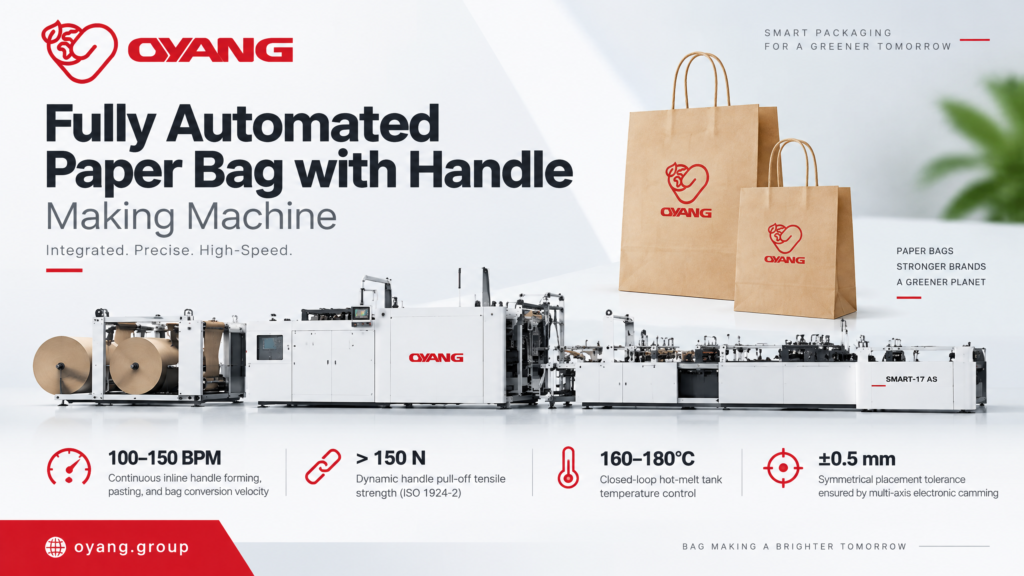
A fully automated paper bag with handle making machine (also engineered as a square bottom paper bag making machine with handle or inline paper bag making machine with handle) eliminates downstream manual labor by integrating continuous handle formation, flying rotary shear cutoff, hot-melt adhesive dispensing, and pressurized base-web transfer into a single synchronized kinematic train. Operating on an integrated twisted paper rope handle making machine or flat-fold configuration, heavy-duty production units such as the OYANG 16A and SMART-17 AS achieve stable production speeds of 100 to 150 bags per minute, executing inline handle placement within ±0.5 mm registration accuracy and dynamic tensile bond strengths exceeding 150 N across 70–170 GSM kraft web substrates.
Kinematic Principles of Inline Handle Making and Pasting
In legacy retail packaging operations, paper bag conversion and handle attachment were separated into distinct manual or semi-automated offline stages. An operator had to transfer pallets of finished SOS sacks to a standalone paper bag handle pasting machine, consuming floor footprint, introducing handling scuffs, and limiting throughput to 30–40 bags per operator hour.
A high-speed industrial paper hand bag making machine integrates two discrete manufacturing lines into one master electronic clock:
- The Primary Reel Converting Line: Unwinds, slits, scores, and forms the main kraft sack tube.
- The Auxiliary Handle Fabrication Sub-Assembly: Pulls narrow kraft paper patches from roll stock, inserts twisted paper cords or folded flat paper tapes, coats the bonding interface with pressurized hot-melt glue, shears the individual handle assemblies, and matches their velocity to the moving web.
To maintain structural integrity without tearing paper fibers, modern lines eliminate mechanical chain slip by driving the handle feed wheels and rotary flying knives with high-response servo motors governed by dedicated motion controllers (such as Trio or Siemens SIMOTION).
Mechanical Breakdown: The Inline Handle Fabrication Sub-Assembly
Producing strong, aesthetically flawless carrier bags requires micrometer-level mechanical synchronization. The handle module on an industrial paper handle making machine executes four discrete kinematic events inside an operation cycle lasting less than 0.4 seconds:
1. Continuous Cord Feeding & Looping Mechanics
In a twisted paper handle making machine, two reels of twisted paper rope (typically 3–5 mm diameter) are pulled by knurled metering rollers. Rotating mechanical finger arms catch the continuous rope, looping it into a symmetrical “U” profile. Simultaneously, the bottom kraft backing tape is unwound, grooved, and guided beneath the rope loop to form the handle patch.
2. High-Speed Rotary Flying Shear
Severing tightly twisted paper fiber demands high shear velocity to prevent frayed yarn ends. Modern paper rope handle making machine stations employ dual-action rotary flying knives driven by independent servo axes. The knife accelerates to match the web surface speed at the exact point of cut, executing a clean 90-degree guillotine slice across the rope and backing patch before retracting.
3. Pressurized Hot-Melt Adhesive Dispensing (160–180°C)
Adhesive bonding strength is governed by open time, application temperature, and coat weight. Closed-loop hot-melt tank systems pump EVA or metallocene-based adhesive at 160 to 180°C through multi-orifice extrusion nozzles. Multi-track glue beads (0.8 to 1.2 mm width) are applied directly to the patch surfaces. Non-drip pneumatic cut-off needles eliminate adhesive trailing, ensuring zero glue transfer onto idler guide rollers.
4. High-Pressure Secondary Nip Rollers
A common cause of handle pull-off failure under grocery loads is premature crystallization of the adhesive prior to fiber penetration. In an OYANG paper bag handle pasting machine, the freshly glued patch is pressed against the inside lip of the main paper web, then immediately routed through dual spring-loaded secondary calender nip rollers (delivering 0.4 to 0.6 MPa mechanical compression). This drives molten adhesive deep into the paper pores, achieving fiber-tearing bond strength before the tube enters the tube-forming plow.
Engineering Video: Inline Handle Making & Pasting Kinematics in Real-Time
Observe the synchronized flying rotary cutter, dual-rope looping arms, and continuous high-pressure nip assembly running on the OYANG 16A production line:
Video 1: Real-time operational kinematics of the OYANG 16A inline handle forming and pasting system.
Field Engineering Diagnosis: Troubleshooting Inline Handle Defects
Inline handle attachment operates at the intersection of thermal, pneumatic, and mechanical dynamics. When line speed exceeds 120 bags/min, subtle timing deviations create downstream reject bundles. Use this diagnostic matrix for shop-floor troubleshooting:
| Handle Quality Defect | Root Kinematic / Thermal Cause | Standard Workshop Calibration Protocol |
|---|---|---|
| Handle Pull-Off Failure (< 100 N) | Glue open-time exceeded; adhesive nozzle temp below 155°C, or insufficient nip roll pressure. | Raise tank/hose temps to 175°C; verify open-time is < 0.25 s; adjust secondary nip pneumatic cylinder to 0.5 MPa. |
| Asymmetrical Handle Pitch (> 1.5 mm skew) | Differential rope slip in draw rollers; phase lag between left and right looping finger linkages. | Inspect knurled feed wheel grooves for paper debris; recalibrate secondary servo electronic camming offset via HMI. |
| Adhesive Stringing / Guide Contamination | Degraded nozzle cut-off needle seals; hot-melt viscosity mismatch (viscosity > 2,500 mPa·s at 170°C). | Purge glue manifold; replace nozzle tip; transition to high-cohesion packaging-grade EVA with 1,200–1,600 mPa·s profile. |
| Paper Web Tear at Handle Base | Patch cutting anvil dullness creating ragged edges; over-penetration of tube forming forming horns. | Regrind or index carbide flying knife blades; back off forming plate clearance by 0.3 mm to prevent impact tearing. |
Twisted Paper Rope vs. Flat Handle: Mechanical Tooling Comparison
Converting facilities must match machine tooling to the intended end-use retail market. A paper bag making machine with flat handle utilizes a continuous flat kraft strip folded into multi-ply straps, whereas a round rope system requires dedicated twisted rope twisting heads:
| Technical Parameter | Twisted Rope Handle Line (OYANG 16A) | Flat Folded Handle Line (SMART-17 AS) |
|---|---|---|
| Handle Raw Material | Twisted paper rope rolls (dia. 3.5 – 5 mm) + kraft patch | Flat paper roll (width 80 – 100 mm, 4-fold automated forming) |
| Maximum Rated Speed | 100 – 150 bags/min | 120 – 180 bags/min |
| Handle Loop Height | 90 – 100 mm standard | 100 – 110 mm standard |
| Patch Paper Grammage | 100 – 150 g/m2 | 100 – 140 g/m2 |
| Patch Dimensions | Width 40–50 mm; Length 152–190 mm | Width 35–45 mm; Length 140–160 mm |
| Primary Retail Application | Boutique apparel, cosmetics, department store luxury packaging | Food delivery, fast-casual takeout, high-capacity grocery shopping |
OYANG Advanced Machinery Platforms for Carrier Bag Conversion
Operating high-speed inline handle applicators requires extreme vibration resistance. Continuous reciprocal cutting impacts will deflect lightweight welded machine plates, causing patch misalignment. All OYANG wall panels are cast from heavy-density HT250 gray cast iron, pre-aged to relieve internal stresses, and precision-machined in climate-controlled MAZAK flexible production lines within ≤ 0.015 mm tolerances:
1. OYANG 16A: Automated Twisted & Flat Handle SOS Converting Line
The OYANG 16A Full Auto Twisted & Flat Rope Handle Paper Bag Machine serves as the industrial standard for premium carrier sack converters. It features quick-interchange tooling that switches between round twisted rope and flat folded tape handles. Equipped with automatic paper tension regulation and computerized Nordson adhesive delivery, the 16A handles bag face widths from 150 to 330 mm at production speeds up to 150 bags/min.

Figure 1: The OYANG 16A Automatic Paper Bag Machine running inline twisted rope carrier production.
2. SMART-17 AS: High-Speed Flat Handle Line with Inline Fold-In Unit
Engineered for high-volume takeaway packaging where bags must be neatly stacked inside shipping cartons without protruding handles, the SMART-17 AS Automatic Flat Handle Paper Bag Machine incorporates an automatic internal fold-in mechanism. After handle pasting, pneumatic folding tines tuck the handles inside the bag mouth prior to final bottom folding, enabling ultra-compact shipping volume.

Figure 2: The SMART-17 AS Flat Handle Paper Bag Machine with automated internal fold-in functionality.
For plants balancing semi-automatic production bases with separate handle gluing cells, consult our operational report on semi-automatic vs. fully automatic bag machines: Labor vs. automation guide.
To review our multi-axis servo synchronization architecture and roll-fed kinematic sequences, explore our complete technical guide on OYANG Paper Bag Machine Guide: High-Speed Smart Packaging Solutions.
To verify the CNC machining tolerances and quality management standards behind our equipment, read about Ounuo Machinery: High-Precision Eco-Packaging Manufacturing at OYANG Group.
Related Technical Guides & Converting Resources
- → How Paper Bag Making Machine Works: Step-by-step kinematic sequence, servo axis coordination, and bottom-folding mechanics.
- → OYANG Paper Bag Machine Guide: In-depth technical breakdown of the TECH-18 and SMART-17 converting lines, servo kinematics, and inline handle integration.
- → Semi-Automatic vs. Fully Automatic Bag Machines: Labor overhead, format flexibility, and unit break-even comparisons.
- → Ounuo Machinery High-Precision Manufacturing: Explore the Japanese MAZAK and OKUMA 5-axis CNC machining bays powering OYANG Group’s machinery lines.
Frequently Asked Questions (FAQ)
What is the primary operational advantage of an inline paper bag with handle making machine over offline handle pasting?
An inline handle making machine eliminates the intermediate palletizing, manual loading, and secondary handling labor required by offline pasting cells. By forming, gluing, and attaching handles directly onto the continuous web before tube forming, the line cuts direct labor requirements by 60 to 75% while maintaining placement accuracy within ±0.5 mm at 150 bags/min.
Can a single machine switch between twisted paper rope handles and flat paper handles?
Yes. Advanced converting platforms like the OYANG 16A feature modular handle forming stations. Operators can change from twisted paper rope looping fingers to a 4-fold flat tape folding assembly within approximately 2 to 3 hours by swapping the guide plates, knurled drive wheels, and flying shear anvil sets.
What type of adhesive ensures optimal bond strength for heavy-duty shopping sacks?
Heavy retail shopping sacks rely on fast-setting thermoplastic EVA or metallocene hot-melt adhesives applied at 160–180°C. Metallocene hot-melts offer superior thermal stability, zero nozzle charring, and rapid tack (under 0.3 seconds open time), allowing instant fiber bond formation under high-speed calender nip rollers to withstand dynamic pull forces > 150 N.
Why are secondary pneumatic nip rollers critical after inline handle placement?
Secondary pneumatic nip rollers apply immediate calibrated mechanical pressure (0.4 to 0.6 MPa) directly across the freshly glued handle patch and moving base web. This mechanical compression forces the molten hot-melt adhesive deep into the paper fiber matrix before it crystallizes, preventing catastrophic handle delamination under heavy grocery loads.