

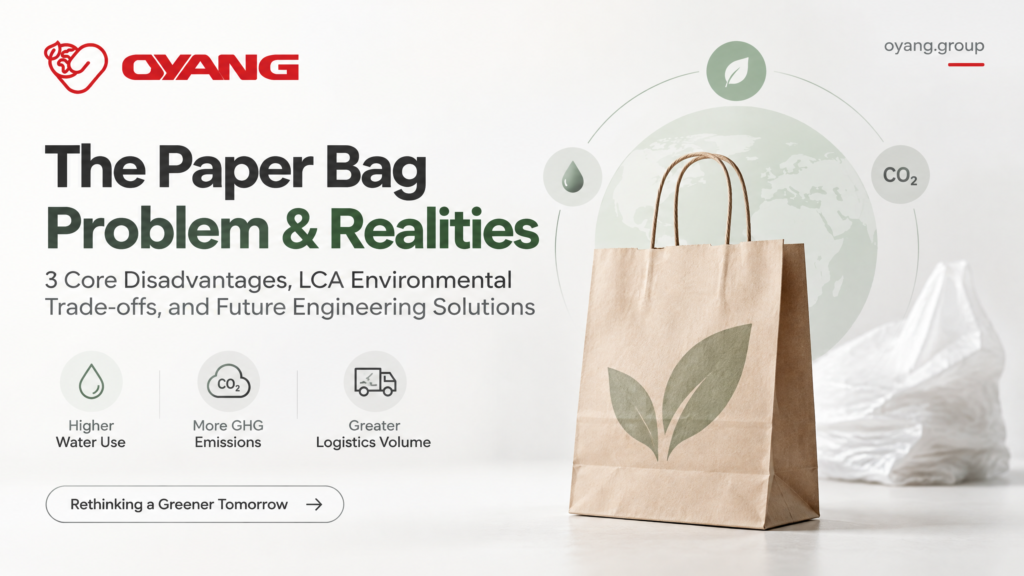
The Paper Bag Problem & Realities: 3 Core Disadvantages, LCA Environmental Trade-offs, and Future Engineering Solutions
What Are 3 Disadvantages of Paper Bags? Engineering Reality vs. Green Perception
From the perspective of a plant production engineer, paper is not a universal panacea. Evaluating the negatives of paper bags requires examining their physical behavior and operational logistics:
1. Severe Wet Tensile Degradation
Cellulose fibers bond via hydrogen bonds. When exposed to liquid water, atmospheric humidity above 85% RH, or condensation from chilled groceries, water molecules disrupt these inter-fiber bonds. Standard un-sized kraft paper loses up to 85%–90% of its dry tensile strength within minutes, causing sudden bottom rupture under standard retail loads.
2. High Bulk Density & Logistics Fuel Costs
A standard 70 GSM kraft shopping bag weighs roughly 35 to 55 grams, compared to 5 to 8 grams for an equivalent high-density polyethylene (HDPE) film bag. Paper bags occupy 5 to 7 times more physical storage volume on warehouse pallets. Delivering 1 million paper bags requires up to 6 full semi-trailer truckloads, compared to just 1 truckload for plastic carriers, multiplying secondary transport carbon emissions.
3. Higher Upstream Manufacturing Footprint
Chemical kraft pulping requires substantial thermal energy for wood digestion, black liquor evaporation, and roll drying calenders. Producing 1,000 virgin paper bags consumes approximately 3,800 liters of water and roughly 2,500 MJ of total primary energy, demanding multiple reuse cycles by end-consumers to achieve net carbon parity with synthetic alternatives.
Life Cycle Assessment (LCA) Benchmark: Virgin Paper vs. Recycled Paper vs. HDPE
Rigorous ISO 14040/44 life cycle assessments conducted across governmental environmental agencies (such as the UK Environment Agency and the Danish EPA) demonstrate that the environmental footprint of carrier bags depends heavily on raw material furnish and reuse rates:
| LCA Impact Dimension (Per 1,000 Bags) | Virgin Kraft Paper (100% Bleached/Unbleached) | Recycled Kraft Paper (100% Post-Consumer) | Virgin HDPE Plastic Bag (Baseline) |
|---|---|---|---|
| Global Warming Potential (kg CO2 eq) | 45.2 – 62.0 | 24.5 – 35.8 | 14.8 – 20.4 |
| Freshwater Consumption (Liters) | 3,200 – 4,100 | 1,100 – 1,600 | 180 – 260 |
| Solid Waste Generated (kg) | 34.0 – 48.0 | 18.0 – 26.0 | 7.0 – 11.5 |
| Reuse Cycles Needed to Neutralize Carbon | 3 to 7 Reuses | 2 to 4 Reuses | 1 Reuse (Baseline) |
| End-of-Life Environmental Fate | 100% Biodegradable; Recyclable 5–7 times | 100% Biodegradable; Recyclable 3–4 times | 400+ Years Environmental Persistence (Microplastics) |
This lifecycle dynamic explains why industrial converters are transitioning toward high-yield recycled testliner substrates and lightweight virgin paper. To model precise plant manufacturing economics and paper gsm yield per roll, consult our engineering guide on how much does it cost to produce a paper bag.
Engineering Countermeasures: How Advanced Packaging Machinery Solves the “Paper Bag Problem”
Modern mechanical engineering tackles these historical paper limitations through three integrated technology vectors:
1. Repulpable Aqueous Dispersion & Extrusion Barrier Technology
Instead of laminating non-recyclable thick polyethylene (PE) films, converters apply sub-micron water-based dispersion barrier coatings or biodegradable biopolymers (PLA/PBS) directly to kraft webs using industrial systems like the OYANG Extrusion Coating & Lamination Line. This achieves grease resistance (KIT ≥ 9) and moisture-proof Cobb values (< 15 g/m²) while retaining 100% repulpability in standard cardboard pulpers.
2. High-TEA Lightweight Down-Gauging
Rather than running rigid 120 GSM kraft rolls, precision converting machines leverage extensible sack kraft (Clupak micro-creping) and high-TEA virgin fibers running at just 55 to 70 GSM. This reduces raw material mass by 35% without sacrificing payload strength. To see how automated servo mechanisms handle high-speed down-gauged paper web without snapping, read our analysis on how does a paper bag machine work.
3. Beyond Flat Bags: Molded Pulp & 3D Paper Forming
For rigid and semi-rigid containment where folded paper bags remain mechanically unsuitable (e.g., liquid delivery, hot soup bowls, and structured catering trays), converters combine flat bag lines with molded paper forming systems, utilizing the OYANG Multi-Layer Paper Forming Machine (Part I) and Paper Sealing Machine (Part II).
What Is the Size and Value of the Paper Bag Market? Target Sectors & Future Growth
Global packaging market intelligence values the global paper bag market at approximately $5.2 billion to $5.6 billion USD, with projections to expand past $7.8 billion to $8.4 billion USD by 2030, registering a compound annual growth rate (CAGR) of 4.8% to 5.4%.
What Is the Target Market for Paper Bags?
- Food Delivery & Quick Service Restaurants (QSR): Square-bottom SOS kraft takeaway bags capable of holding grease-resistant containers vertically without tipping.
- Supermarket & Grocery Chains: Heavy-duty virgin kraft bags with twisted paper handles (10 to 15 kg capacity) replacing single-use checkout plastic.
- Retail, Apparel & Luxury Goods: Premium bleached white kraft bags with inline 4-color flexo branding or non-creased box carriers made via sheet-fed systems like the Great 4.0 Supreme.
- Bakery & Pharmaceutical Dispensaries: High-speed pinch-bottom (V-bottom) bags produced on lines like the OYANG 16C V-Bottom Machine.
Converters asking what is the future of paper bags are moving away from manual and semi-automatic units toward agile, multi-servo production centers. For complete industrial factory planning, review our tutorial on how to start making paper bags.
OYANG Engineering Practice: Precision Manufacturing for Low-Scrap Converting
Because paper has lower tensile elongation than synthetic polymers, mechanical vibrations or slight shaft deflections on high-speed machines induce sudden web snapping. Inside OYANG’s 130,000 m² production complex, all core machine side-walls, rotary cutter shafts, and bottoming drums are machined using Japanese MAZAK and OKUMA CNC multi-axis centers to tolerances of ≤ 0.015 mm.

Figure 1: OYANG SMART-17 high-speed roll-fed paper bag production system engineered for 180–220 bags/min continuous operation with material scrap below 1.2%.
This mechanical rigidity, combined with bus-synchronized electronic line shaft (ELS) servos, allows converters to run lightweight 45–60 GSM kraft webs without tear-outs, restricting material waste to ≤ 1.2% and directly mitigating the environmental and cost footprint of paper converting.
Download Resource: Access comprehensive line layouts, energy ratings, and technical specs in the OYANG Paper Bag Machine Solution Brochure (PDF).
Video Insight: Watch multi-servo high-speed converting in real time: SMART-17 High-Speed Paper Bag Machine Factory Run Video.
Related Engineering Guides & Technical Resources
Frequently Asked Questions (FAQ)
What are the disadvantages of paper bags?
The disadvantages of paper bags include their vulnerability to water and moisture, higher storage and transport bulk volume requiring more freight fuel, and higher manufacturing energy and water consumption compared to lightweight plastic films.
What are 3 disadvantages of paper bags compared to plastic?
The 3 primary disadvantages of paper bags are: 1) low wet strength causing bags to tear when exposed to liquid or condensation, 2) heavy bulk density occupying up to 5 to 7 times more storage and transport volume, and 3) higher upstream greenhouse gas emissions and water usage during wood pulping.
What is the paper bag problem?
The paper bag problem refers to the environmental paradox where producing a paper bag requires significantly more energy, water, and transport fuel than an ultra-thin HDPE plastic bag, meaning consumers must reuse a paper bag 3 to 7 times before it matches the carbon footprint of a plastic carrier.
What is the size and value of the global paper bag market?
The global paper bag market is valued at approximately $5.2 billion to $5.6 billion USD and is projected to surpass $7.8 billion to $8.4 billion USD by 2030, driven by bans on single-use plastics and growing retail demand across food delivery and supermarkets.
What is the future of paper bags in sustainable packaging?
The future of paper bags relies on repulpable water-based dispersion barrier coatings that provide water and grease resistance without plastic lamination, lightweight high-TEA paper formulations, and high-speed multi-servo converting lines with automated size changes.