350x97.png)
350x97.png)
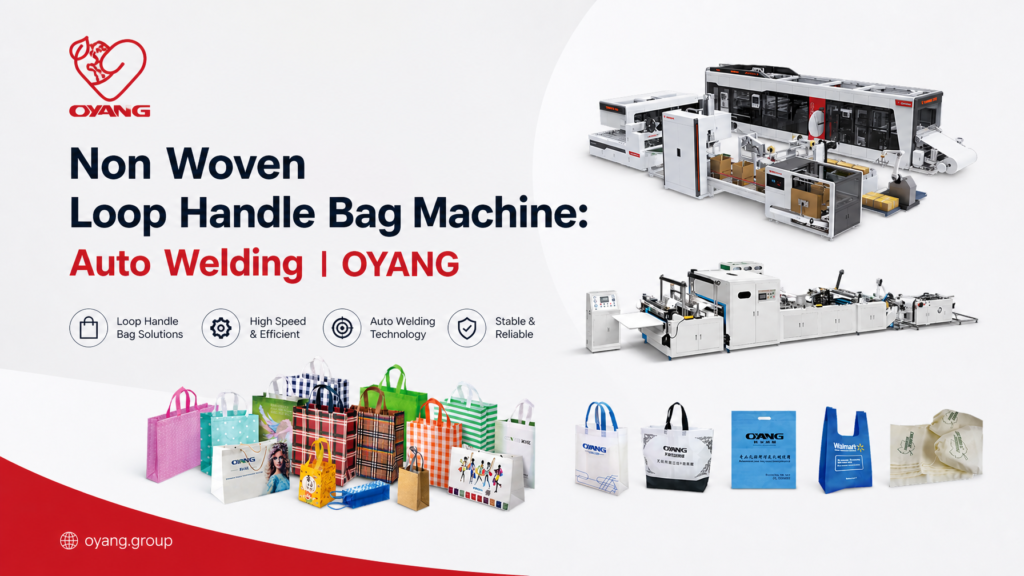
Non Woven Loop Handle Bag Making Machine: Inline Automated Welding Architecture
A high-performance non woven loop handle bag making machine integrates rollstock unwinding, continuous tension management, automated handle coil slitting, pneumatic loop orientation, and digital ultrasonic welding within a single synchronized converting line. Eliminating offline manual handle positioning entirely, advanced systems like the OYANG TECH and OYANG 20 series utilize dual-stage servo secondary positioning to guarantee handle placement symmetry within ±0.5 mm at 100 bags per minute, delivering verified joint tensile peel strengths exceeding 150 N (>15.3 kgf).
Inline Automated Welding vs Offline Manual Stamping: Economic & Structural Gap
In high-volume commercial retail, take-away catering, and eco-friendly packaging sectors, the carry handle represents the most structurally vulnerable element of a bag. Commercial converters transitioning from semi-automatic or offline assembly to an integrated non woven carry bag making machine face stark differences in manufacturing economics, scrap rates, and payload reliability:
| Engineering Parameter | Offline Manual / Semi-Auto Handle Welder | OYANG Continuous Inline Handle Attaching System |
|---|---|---|
| Production Velocity | 20 – 30 bags/min (Operator speed dependent) | 80 – 100 bags/min (Continuous synchronized bus) |
| Labor Requirement | 2 – 3 Dedicated operators per line | 0 Extra labor (Integrated inline station) |
| Handle Alignment Tolerance | ±2.5 mm to ±4.0 mm (Manual eye alignment) | ≤ ±0.5 mm (Servo-driven secondary positioning) |
| Handle Tensile Burst Strength | 80 – 110 N (Inconsistent manual dwell time) | > 150 N (Real-time ultrasonic energy monitoring) |
| Raw Material Scrappage | 3.0% – 5.5% (Misalignment & cold welds) | < 1.5% (Synchronized photocell tracking) |
Engineering Architecture: How Inline Handle Forming & Welding Works
Attaching soft loop handles to a continuously advancing polypropylene web requires microsecond motion coordination. On an OYANG loop handle bag making machine, the handle mechanism operates as a high-speed mechatronic sub-assembly:
Phase 1 Rollstock Feeding & Edge Folding
Narrow non-woven master rolls (typically 40–80 mm wide, 70–100 GSM) are unwound from dual dedicated creel stands. Mechanical edge-folders curl the outer edges inward to form double- or triple-layer reinforced strap webs, increasing lateral tensile rigidity before welding.
Phase 2 Servo Precision Feeding & Shear Cutting
A digital servo motor indexes the continuous handle web into a rotary guillotine. The cutting sequence is synchronized with the primary bag body pitch, holding cut length accuracy within ±0.3 mm (standard handle length: 360–420 mm).
Phase 3 Pneumatic Twist & Loop Orientation
High-speed pneumatic rotary grippers clamp both ends of the sheared strap, executing a 180-degree inward twist. This motion forms the flat strap into an open, U-shaped soft carry loop ready for flat placement against the folded top hem of the advancing bag body.
Phase 4 Secondary Servo Registration (Zero-Drift Positioning)
To eliminate web slip caused by high-speed kinetic inertia, an auxiliary optical-servo positioning stage grips the loop ends. It aligns them precisely across the bag mouth foldline, locking position tolerance strictly within ±0.5 mm prior to acoustic horn engagement.
Phase 5 20 kHz Ultrasonic Molecular Fusion
High-amplitude 20 kHz titanium sonotrodes descend upon hardened textured steel anvils. Ultrasonic acoustic friction melts polymer chains across both interfaces simultaneously within 0.12 seconds, creating a molecular cross-link matrix with zero needle puncture holes.
Tensile Integrity: How OYANG Exceeds >150 N Pull Strength
Retail carry bags carrying heavy canned groceries, glass beverages, or take-out containers must withstand sudden downward impact forces (jerk loading). A commercial failure point occurs when ultrasonic horns either “cold seal” (insufficient polymer melt) or “over-penetrate” (cutting the non-woven fibers).
OYANG’s automatic handle attaching machine solves this via three closed-loop control features:
- Digital Auto-Tracking Ultrasonic Generators: Monitors transducer impedance dynamically. If horn thermal expansion shifts resonance from 20,000 Hz to 20,080 Hz, the generator auto-adjusts within 5 milliseconds, maintaining constant acoustic amplitude.
- Pneumatic Proportional Valve Pressure Regulation: Replaces rigid mechanical cams with high-speed proportional valves, ensuring uniform compression force (0.4–0.6 MPa) regardless of substrate thickness fluctuations.
- Embossed Honeycomb Anvil Pattern: Concentrates acoustic energy into micro-pyramidal contact points, yielding a continuous, tear-resistant weld footprint that routinely tests above 165 N in universal tensile testing machines (ASTM D5034 standard).
Rigid Mechanical Base: Japanese MAZAK & OKUMA Machining Centers
The handle attaching module cycles twice per second when running at 100 bags/min. If the support frame or rotating arm exhibits micro-deflection, the ultrasonic anvil and horn face lose parallel alignment, leading to uneven joint strength across the left and right weld tabs.
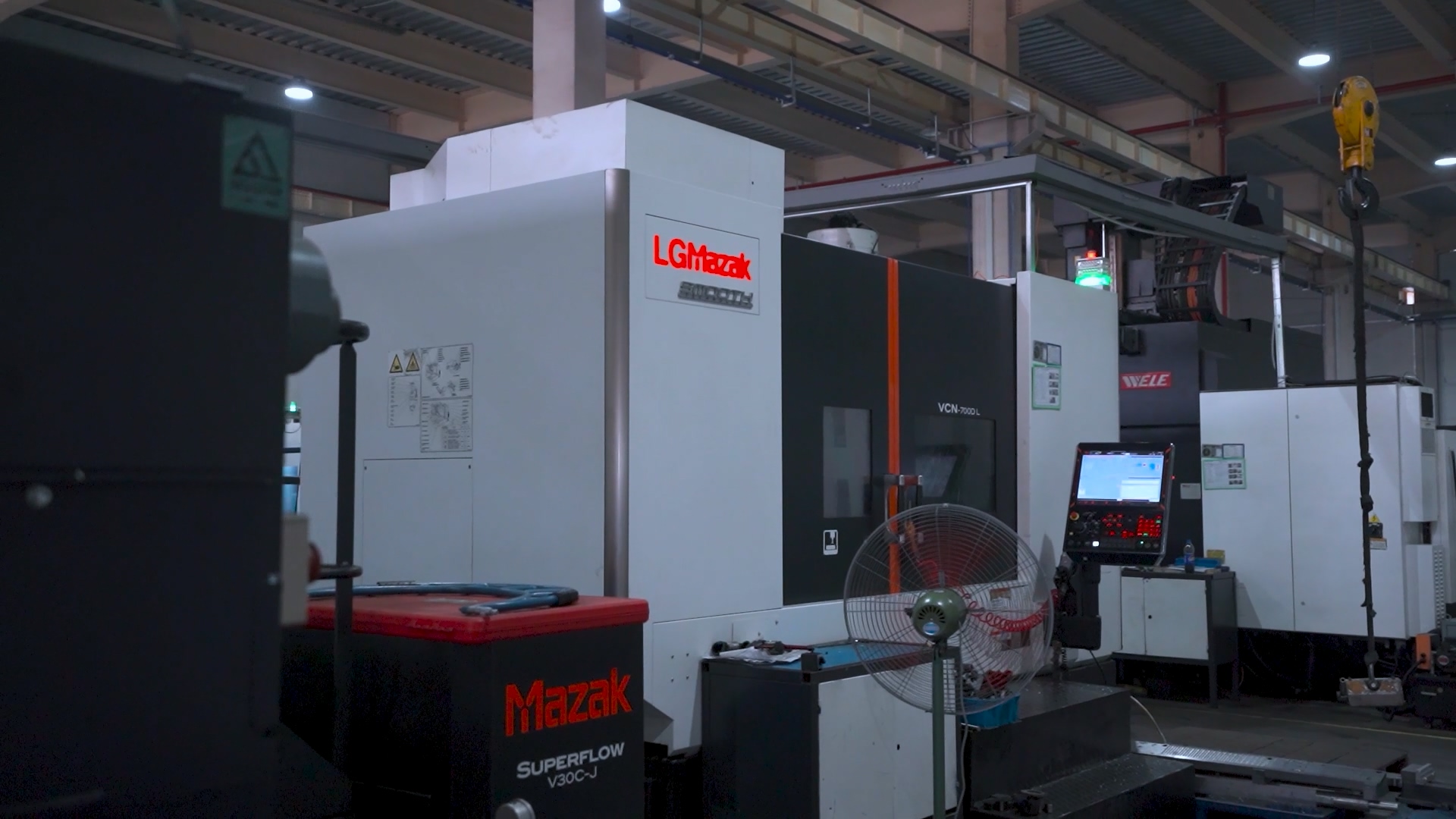
Structural uprights, anvil mounts, and rotating arm housings processed on Japanese MAZAK CNC lines inside OYANG’s 130,000㎡ plant.
All handle station uprights, cam tracks, and horn mounting plates are machined to geometric tolerances of ≤ 0.015 mm on Japanese MAZAK and OKUMA 5-axis CNC machining centers. This structural rigidity prevents harmonic vibration and ensures long-term parallel anvil contact over hundreds of millions of cycles.
Featured Machinery with Integrated Loop Handle Technology

TECH-23 Fully Automatic 3D Line
Flagship 100 bags/min converting platform. Includes inline loop handle attachment, 90-second motorized auto mold changeover, and 50-axis servo motion control.
View TECH 23 Specifications
OYANG-20 High-Speed Converting Unit
Industrial workhorse running 80–100 bags/min with full inline loop handle sealing, heavy-duty gusset folding, and precise optical registration.
View OYANG 20 Specifications
OYANG15-F700 Standalone Handle Sealer
Dedicated semi-automatic soft handle ultrasonic machine. Designed for small-batch converting, bag repair, or retrofitting legacy manual bag assembly stations.
View OYANG15-F700 SpecsFrequently Asked Questions (FAQ)
What is a non woven loop handle bag making machine?
A non woven loop handle bag making machine is an automated industrial packaging line that fabricates flat or three-dimensional non-woven bags while automatically slitting, forming, and ultrasonically welding soft loop carry handles directly onto the bag mouth in a continuous sequence.
How does inline handle welding differ from manual handle pasting?
Inline handle welding automatically feeds handle tape, cuts it to length, turns it into a loop, and fuses it with ultrasonic horns at speeds up to 100 bags per minute with 0 manual operators. Manual handle pasting requires operators to physically place pre-cut handles onto a foot-pedal welder, which limits output to 20 to 30 bags per minute and leads to inconsistent weld strength.
What is the minimum tensile pull strength of an ultrasonically welded handle?
On an OYANG continuous loop handle converting line, the welded joint achieves a tensile peel strength exceeding 150 N (>15.3 kgf) per handle tab, ensuring that a completed bag can comfortably carry retail payloads of 15 to 20 kg without joint rupture.
Can a loop handle bag making machine handle both 3D box bags and flat bags?
Yes, versatile converting models like the OYANG TECH series and multi-functional XB series can attach loop handles to both 3D box bags with side gussets and standard 2D flat bags by selecting different operating modes on the central HMI touchscreen.
What type of non-woven fabric is best suited for loop handles?
Standard polypropylene (PP) spunbond fabric between 70 and 100 GSM is the preferred substrate for soft loop handles. It provides optimal tensile stiffness for feeding through rotary loop turners and melts cleanly under 20 kHz ultrasonic horns to create strong molecular bonds.
Automate Your Handle Welding & Eliminate Manual Labor
Discover how OYANG’s inline loop handle systems achieve 100 bags/min continuous velocity with pull strengths exceeding 150 N. Speak with an application engineer to plan your converting layout today.