350x97.png)
350x97.png)
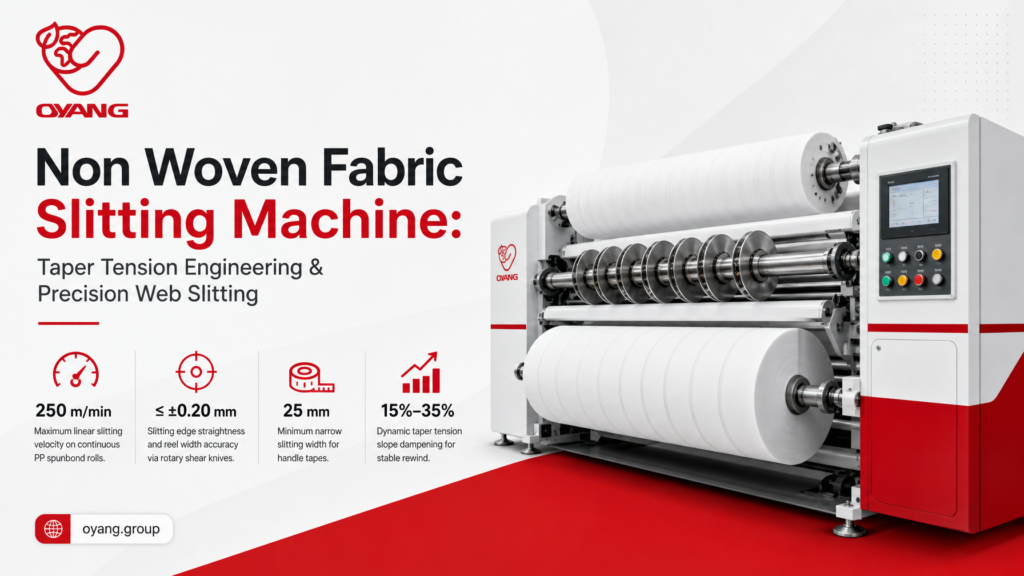
Non Woven Fabric Slitting Machine: Taper Tension Engineering & Precision Web Slitting
A high-speed non woven fabric slitting machine (such as the OYANG ONL-XE1800) slits wide parent rolls (1,600mm–1,800mm) into narrow slit reels for bag bodies, gusset piping, and 25mm–35mm handle tapes at operating velocities up to 250 m/min. Utilizing dual air-expanding rewind shafts coupled with closed-loop servo taper tension attenuation (15%–35%), rotary shear-cut circular knives maintain slitting edge tolerances within ≤ ±0.20mm. This system eliminates common converting defects such as roll telescoping, core crushing, and filament edge fraying across 30–120 g/m² polypropylene spunbond rolls.
Maximum linear slitting velocity on continuous polypropylene spunbond parent rolls.
Slitting edge straightness and reel width accuracy via pneumatic rotary shear knives.
Minimum narrow slitting width achievable for automated nonwoven bag handle strips.
Dynamic taper tension slope dampening inward radial roll pressure during rewinding.
Slitting Tooling Dynamics: Rotary Circular Shear vs. Razor vs. Score Cutting
Nonwoven polypropylene (PP) consists of thermally calendered random continuous filaments. Unlike woven textiles or homogenous plastic films, improper cutting tooling shears the web irregularly, tearing individual fibers and generating airborne debris that foul subsequent photoelectric registration sensors on automatic bag making lines.
1. Rotary Circular Shear Knives (Top & Bottom Anvil): The Standard for Spunbond
The superior mechanism for converting 30–120 g/m² PP nonwovens is rotary circular shear slitting. An upper spring-loaded or pneumatically actuated dish blade rotates against a driven lower circular anvil ring mounted on a hardened mandrel shaft. The optimal cutting intersection requires a blade overlap depth of 0.5mm to 0.8mm and a shear contact angle of 1.0° to 1.5°. This creates a clean scissor action that slices through polypropylene fibers instantly without generating loose filament strands or melted edge beads.
2. Razor Blade Slitting: Limitations on Textured Webs
While inexpensive and easy to configure for thin films (<25μm BOPP), razor slitting fails on spunbond nonwovens exceeding 40 g/m². The high tensile resistance of bundled filaments causes rapid micro-dulling of the stationary razor edge within 2 to 4 operating hours. The blunted blade pulls and stretches fibers before tearing them, resulting in “ragged scalloped edges” and severe roll diameter variation across narrow slit reels.
| Slitting Mechanism | Edge Quality on Nonwoven | Airborne Dust & Fiber Debris | Blade Tooling Life | Ideal Converting Function |
|---|---|---|---|---|
| Rotary Shear (Dish / Anvil) | Excellent (±0.20mm, crisp edge) | Extremely low (Clean scissor cut) | 1,500 – 2,500 Operating hours | Bag body rolls, 25mm–35mm handle tapes |
| Pneumatic Score / Crush Cut | Moderate (Fibers compacted) | Low to moderate | 400 – 800 Operating hours | Fast setup on wide multi-cut webs |
| Stationary Razor in Air/Groove | Poor (Fibers pulled & stretched) | High (Severe lint generation) | 2 – 8 Operating hours (Fast wear) | Ultra-lightweight nonwovens (<25 g/m²) only |
Physics of Rewind Taper Tension: Preventing Telescoping and Core Crush
During roll rewinding, as the wound roll diameter ($$D$$) increases from an initial 76mm (3-inch) core to a finished 800mm–1,000mm outer diameter, the cumulative radial pressure exerted by outer nonwoven wraps transfers inward toward the core. If rewind tension remains constant (flat tension), the immense internal hoop stress leads to two catastrophic structural failures:
1. The Telescoping Defect (“Cigar Rolling”)
When the internal layers of a wound reel are subjected to excessive radial pressure, trapped air escapes laterally. The core layers lose frictional grip against the shaft and slide axially outward under slight side-thrust, producing conical, stepped ends (“telescoped rolls”). Telescoped rolls cannot be loaded onto bag machine unwinds without colliding with side guides.
2. Core Collapse & Starburst Pin-Wheeling
On heavy 80–120 g/m² nonwovens, constant tension winding generates hundreds of kilograms of inward compressive force. The paper core deforms or completely crushes inward. When removed from the air shaft, the roll interior buckles into a characteristic “starburst” pattern, preventing operators from inserting mechanical unwind chucks on the bag making line.
Closed-Loop Taper Tension Equation Implemented on OYANG Slitters:
T(D) = T₀ × [ 1 - (K_taper / 100) × ( (D - D_core) / (D_max - D_core) ) ]
Where: T(D) = Instantaneous Rewind Tension; T₀ = Initial Starting Tension; K_taper = Taper Percentage (typically set to 20%–30% for spunbond PP); D = Real-time Roll Diameter; D_core = Core Diameter; D_max = Final Target Diameter.
Magnetic Powder Brake vs. Dual Closed-Loop AC Servo Rewind Drives
The core technological divide between budget nonwoven slitters and industrial slitter rewinders lies in how torque and web speed are governed across dynamic roll expansions:
| System Architecture | Magnetic Powder Brake / Clutch System | OYANG Closed-Loop Dual AC Servo System |
|---|---|---|
| Torque Response Speed | Slow (200–450 ms response lag) | Instantaneous (≤ 10 ms real-time bus cycle) |
| Thermal Derating & Drift | High; coil heating degrades magnetic torque by 25% | Zero; regenerative servo drives operate at ambient temp |
| Low-Speed Tension Stability | Poor; “stick-slip” jerky friction below 30 m/min | Stable full torque holding from 0.1 m/min to max speed |
| Max Operating Velocity | Limited to 80 – 120 m/min | Continuous 200 – 250 m/min production velocity |
| Narrow Handle Slitting Fit | Difficult; cannot maintain balanced tension on 25mm reels | Differential friction air shafts ensure identical tension per reel |
Featured Platform: OYANG ONL-XE1800 Slitting Machine
Engineered inside OYANG’s 130,000&mflat; CNC base, the ONL-XE1800 is purpose-built to eliminate upstream conversion bottlenecks for high-capacity nonwoven bag factories:

OYANG ONL-XE1800 High-Speed Slitter Rewinder
The industrial flagship web slitter for nonwoven fabrics, plastic films, and barrier laminates. Converts parent rolls up to 1,800mm wide at speeds up to 250 m/min.
- Parent Roll Width: Up to 1,800 mm
- Max Unwind Diameter: Φ 1,200 mm with hydraulic floor pickup
- Rewind Technology: Dual differential air shafts with servo taper control
- Web Guiding (EPC): Ultrasonic edge and line sensor (±0.1mm)
Frequently Asked Questions (FAQ)
Upgrade Your Web Slitting Capacity
Eliminate rewinding defects, reduce trim scrap, and supply your automated bag lines with precision-slit rolls. Contact OYANG converting engineers to discuss customized slitter widths, shear blade configurations, and floor layout integrations.
Download Auxiliary Machinery Brochure (PDF)