350x97.png)
350x97.png)
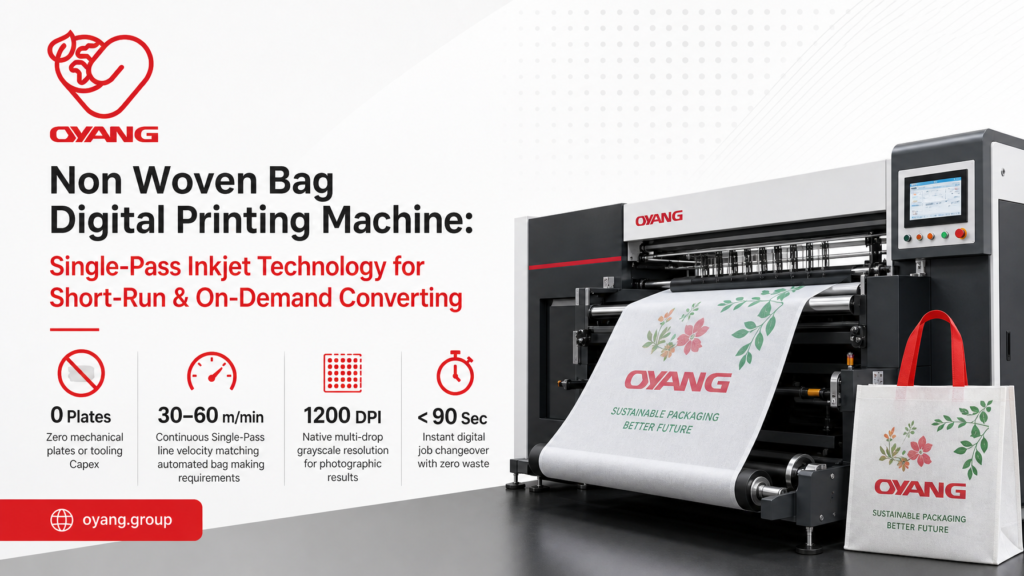
Non Woven Bag Digital Printing Machine: Single-Pass Inkjet Technology for Short-Run & On-Demand Converting
An industrial non woven bag digital printing machine utilizes stationary Single-Pass piezo drop-on-demand (DOD) printhead arrays to deliver photographic CMYK printing directly onto continuous polypropylene (PP) spunbond webs at linear velocities up to 60 m/min. By completely eliminating photopolymer plates, color separation films, and mechanical registration adjustments, Single-Pass technology reduces pre-press setup from 4 hours down to under 90 seconds, enabling profitable short-run customization (1 to 3,000 units), photographic image reproduction at 600×1200 DPI, and instant variable data coding for agile e-commerce supply chains.
Zero mechanical plates or tooling Capex; print directly from RIP vector/raster files.
Continuous Single-Pass line velocity matching automated bag making requirements.
Native multi-drop grayscale resolution reproducing micro-text and photorealistic skin tones.
Instant digital job changeover with zero chemical washup or solvent purge waste.
Single-Pass vs. Multi-Pass Scanning vs. Flexographic Converting
Converters evaluating digital printing on nonwoven shopping and box bags face a critical architectural choice. Traditional wide-format scanning plotters (Multi-Pass) traverse back and forth across a moving substrate; while inexpensive, their low output (20–45 m²/hour) renders them incapable of supplying commercial bag converting lines. Single-Pass printing replaces the reciprocating carriage with a static, full-width printhead bridge under which the web travels continuously.
| Operational Dimension | Industrial Single-Pass Digital | Scanning Multi-Pass Plotter | 4-Color Central Impression Flexo |
|---|---|---|---|
| Production Velocity | 30–60 m/min (Continuous web-fed) | 0.5–1.2 m/min (Intermittent shuttle) | 80–150 m/min (High-speed roll-to-roll) |
| Plate / Cylinder Tooling Cost | $0 USD (Direct file print) | $0 USD (Direct file print) | $250–$600 USD per design set |
| Pre-Press Setup & Make-Ready | < 90 Seconds (File RIP upload) | 3–5 Minutes (Software indexing) | 1.5–3.5 Hours (Plate mounting & register) |
| Start-Up Web Waste per Job | < 2 Meters (Direct electronic sync) | 0.5 Meters (Sheet / small roll feed) | 80–180 Meters (Tension & color tuning) |
| Variable Data & Serialization | Native (Unique QR, barcode per bag) | Supported, but extremely slow | Impossible without offline inkjets |
| Economic Break-Even Run | 1 to 3,500 Bags | 1 to 150 Bags | > 5,000 Bags |
Ink-Substrate Dynamics: Water-Based Pigment on Spunbond Polypropylene
Nonwoven polypropylene presents a low surface energy (typically 30 to 32 dynes/cm) and an irregular fibrous topography composed of thermally calendered diamond or cross-point bonds. Jetted picoliter ink droplets must wet out sufficiently to adhere without excessively wicking along fiber channels (“feathering”).
1. Precision Jetting & Variable Droplet Control
OYANG Single-Pass digital platforms utilize industrial piezoelectric printheads (such as Kyocera or Epson I3200 micro-piezo clusters) with native 600 DPI channel pitch. By modulating the piezoelectric driving waveform, the heads deliver multi-level variable grayscale droplets ranging from 3.5 pl to 14 pl. Ultra-fine 3.5 pl droplets construct smooth photographic skin tones and subtle gradient transitions without banding, while larger 11–14 pl droplets flood saturated solid background blocks, maximizing optical density without exceeding drying capacity.
2. Polymer Surfactant Optimization & Zero Bleeding
Jetting onto polypropylene without solvent etching requires specialized water-based resin-encapsulated pigment inks. These formulations integrate organic co-solvents and fluorinated leveling surfactants that temporarily lower dynamic surface tension to match the nonwoven substrate. Upon contact with the fibrous matrix, a rapid phase inversion occurs: the resin binds the sub-micron pigment particles to the surface while preventing capillary migration into the interstitial fiber voids, maintaining clean line edges down to 0.15mm text sizes.
3. Dual Negative-Pressure Recirculation & Anti-De-priming
In high-speed Single-Pass environments, ink stagnation or micro-air bubbles can cause nozzle dropouts, producing unprinted white streaks across entire rolls. OYANG systems integrate a continuous through-flow negative-pressure ink recirculation system directly behind the nozzle plates. The ink flows across the nozzle orifices at a controlled flow rate, instantly carrying away microscopic air bubbles, suppressing pigment sedimentation, and ensuring stable jetting across 24/7 continuous production shifts.
The Cost Dynamics: When Does Digital Overtake Conventional Printing?
The economic crossover point between Single-Pass digital and flexographic printing is dictated by the amortization of photopolymer plates, pre-press labor, and startup substrate waste. Below is a detailed total conversion cost comparison for an order of 2,000 four-color shopping bags (50 g/m² PP nonwoven, 350mm × 450mm dimensions):
| Cost Component | Conventional 4-Color Flexo | OYANG Single-Pass Digital | Operational Variance |
|---|---|---|---|
| Photopolymer Plates (4 Colors) | $360.00 USD ($90 / plate) | $0.00 USD | -$360.00 Saved |
| Pre-Press Setup Labor (2.0 Hrs) | $50.00 USD ($25 / hr) | $3.75 USD (0.15 Hr file check) | -$46.25 Saved |
| Substrate Startup Waste (120 m) | $28.80 USD (Nonwoven scrap) | $1.20 USD (5 meters web alignment) | -$27.60 Saved |
| Ink Consumable Expense | $14.00 USD (Low-cost flexo ink) | $48.00 USD (Digital pigment ink) | +$34.00 Ink cost premium |
| Cleaning Solvent & Disposal | $12.00 USD (Wash chemicals) | $0.00 USD (Automated cap station) | -$12.00 Saved |
| Total Order Conversion Cost | $464.80 USD | $52.95 USD | Digital Saves 88.6% on 2,000 Bags |
| Unit Printing Cost per Bag | $0.232 USD / Bag | $0.026 USD / Bag | Massive Capex & Time Advantage |
Step-by-Step Workflow: From Customer Vector File to Rewound Roll
Deploying a Single-Pass digital printing line eliminates the convoluted chemistry of plate washing, exposure, and mechanical shimming:
- Automated RIP File Pre-Flight: The operator ingests customer artwork (PDF/TIFF) into the dedicated ColorGATE or Caldera Raster Image Processor (RIP). The software converts RGB photographic gamuts to calibrated CMYK curves and applies ICC color profiles matched to the specific nonwoven fabric density.
- Automated Head Purging & Meniscus Setting: The automated capping station lowers. A motorized vacuum squeegee wipes the nozzle plates, while the digital negative-pressure controller establishes a -1.2 kPa to -1.5 kPa ink meniscus, preventing dripping.
- Continuous Web Infeed & Tension Locking: Nonwoven master rolls are mounted onto the pneumatic expansion shaft. Closed-loop load-cell rollers stabilize web tension at 15 N to 25 N to prevent wrinkles beneath the 1.0mm printhead flying gap.
- Single-Pass Direct Jetting: The nonwoven web advances smoothly under the stationary printhead bridge at 35–50 m/min. Inks are deposited in a single sweep with instant pixel drop placement.
- Medium-Wave Infrared (IR) & Warm-Air Curing: The printed web passes through an enclosed curing tunnel operating at 50°C–58°C. High-velocity air circulation accelerates water flash-off within 6 to 9 seconds, cross-linking the binder resin without shrinking the PP fibers.
- Direct Web Rewind or Inline Bag Converting: The fully dried web is wound onto clean rolls with edge-guiding photoelectric sensors, immediately ready for feeding into automated nonwoven box bag machines (such as the OYANG 16S or TECH 23).
OYANG Industrial Digital Printing Systems
Engineered to bridge the gap between fast e-commerce turnaround and industrial production volumes, OYANG digital systems are built on rigid ductile cast foundations machined inside our 130,000&mflat; CNC base to eliminate mechanical vibrations:

OYANG PSW-1000: Industrial Single-Pass Digital Press
Continuous web-fed digital inkjet printing line engineered for nonwoven fabric rolls, paper webs, and flexible substrates. Designed for short-to-medium runs requiring zero plate costs.
- Max Printing Width: Up to 1000mm full coverage
- Printing Speed: 30–60 m/min continuous velocity
- Color Capability: Industrial CMYK (+ optional White or Spot)
- Resolution: 600 × 1200 native DPI
Video Demonstration: High-Speed Digital Nonwoven Printing in Action
Frequently Asked Questions (FAQ)
Calculate Your Digital Printing Feasibility & ROI
Eliminate plate overhead and capture profitable high-margin short-run packaging orders. Consult with OYANG digital printing application specialists to receive ink consumption calculations, printed fabric samples, and commercial proposals.
Download 2026 Machinery Brochure (PDF)