350x97.png)
350x97.png)
Non Woven Bag Sealing Machine Price Guide & Ultrasonic Tooling Maintenance Manual
Procuring an industrial non woven bag sealing machine involves evaluating capital costs against acoustic stack reliability. Market pricing ranges from $800–$1,800 for manual benchtop spot welders to $2,500–$5,500 for semi-automatic pneumatic units, reaching $6,000–$12,000+ for multi-axis continuous converting assemblies. Ensuring operational efficiency requires proactive maintenance of critical ultrasonic non woven bag sealing machine parts: managing acoustic impedance matching, monitoring titanium (TC4) versus hardened tool steel (D2) sonotrode horn fatigue, and executing digital generator auto-tuning within 19.85 kHz to 20.15 kHz to prevent overload faults.
Commercial Pricing Matrix: Non Woven Bag Sealing Machine Cost Breakdown
When analyzing the commercial non woven sealing machine price, purchasing directors must distinguish between low-duty manual frames and high-duty automated production modules. The table below details capital expenditure, duty cycles, and output capacities:
| Equipment Category | Commercial Price Tier (USD) | Acoustic Power & Frequency | Converting Capacity | Primary Factory Application |
|---|---|---|---|---|
| Manual Benchtop Spot Welder | $800 – $1,800 | 900 W – 1,200 W (28/35 kHz) | 10–15 spot welds/min | Sample making, manual rework, lab testing |
| Semi-Automatic Pneumatic Loop Welder | $2,500 – $5,500 | 1,500 W – 2,000 W (20 kHz) | 35–45 finished bags/min | Handle ribbon welding, box bag corner reinforcement |
| Continuous Rotary Ultrasonic Sewing Machine | $3,200 – $6,800 | 1,800 W – 2,600 W (20 kHz) | Up to 40 meters/min web speed | Continuous edge lacing, trimming, zipper sealing |
| Full-Line Automated Converting Module | $6,000 – $12,000 (per station) | 2,600 W – 3,200 W (20 kHz Bus-Driven) | 90–120 cycles/min continuous | Inline mounting on TECH/SMART high-speed box bag lines |
Evaluating an ultrasonic non woven bag sealing machine price requires looking beyond the purchase invoice. Low-cost analogue generators often lack automatic frequency tracking, causing power loss as the horn heats up. This results in weak seams and eventual transducer burnout that offsets any initial purchase savings.
Acoustic Stack Bill-of-Materials: Components, Lifespan & Metallurgy
The acoustic train on an ultrasonic sealing machine non woven bag platform is a precision-tuned resonance system. Wear or dimensional deviation on any component alters the system impedance, leading to excessive heat generation and generator trip faults:
| Component Name | Material Grade | Typical Lifespan | Primary Failure Mode | Unit Replacement Cost |
|---|---|---|---|---|
| Piezoelectric Transducer | PZT-8 German Ceramics / Aerospace Al | 18,000 – 25,000 hrs | Ceramic disc depoling, electrode oxidation | $280 – $450 |
| Booster Horn (Gain 1:1 to 1:2) | Titanium Ti-6Al-4V or 7075-T6 Al | 20,000+ hrs | Nodal ring O-ring degradation, stud galling | $180 – $320 |
| Welding Sonotrode Horn (TC4) | Aerospace Grade Titanium (TC4) | 12,000 – 16,000 hrs | Acoustic fatigue, face erosion | $420 – $750 |
| Welding Sonotrode Horn (D2) | Vacuum-hardened Tool Steel (D2 / DC53) | 6,000 – 9,000 hrs | Thermal stress cracking, nodal splitting | $220 – $380 |
| Carburized Pattern Anvil Roller | Cr12MoV Alloy Steel (HRC 58–62) | 8,000 – 12,000 hrs | Diamond-knurl point flattening, bearing seizure | $180 – $350 |
| Digital Generator PCB Motherboard | SMT Industrial Control Electronics | 30,000 hrs | IGBT thermal breakdown, dust contamination | $350 – $600 |
Metallurgy Selection: Titanium TC4 vs. Tool Steel D2
Selecting replacement ultrasonic non woven bag sealing machine parts requires balancing mechanical hardness against acoustic elasticity:
- Titanium Ti-6Al-4V (TC4): The industry standard for high-duty converter operations. TC4 offers high acoustic efficiency and low internal dampening, limiting operational temperature rise to under 45°C. Its resonant frequency stays stable across long operating shifts, preventing generator overload trips.
- Hardened Tool Steel (D2 / DC53): Provides superior surface abrasion resistance (HRC 58–60) when running heavily filled nonwoven webs (e.g., 25%–35% calcium carbonate filler). However, because steel exhibits higher acoustic damping than titanium, D2 horns generate more internal heat. They require compressed-air cooling nozzles to prevent frequency drift and thermal stress cracking.
Maintenance SOP: Digital Generator Auto-Tuning & Overload Diagnostics
The primary operational issue reported on shop floors is generator tripping (Error Code E-01 / Overload Trip). This occurs when the acoustic stack moves out of its natural resonant window (19.85 kHz–20.15 kHz). Maintenance teams must follow this step-by-step diagnostic sequence:
Standard Alignment Procedure for 20 kHz Acoustic Stacks
- Mechanical Interface Inspection: Disassemble the sonotrode, booster, and transducer. Clean all mating faces using isopropyl alcohol. Inspect contact surfaces for pitting or fretting corrosion. Re-face worn surfaces using fine 600-grit emery cloth on a granite surface plate.
- Calibrated Stud Torquing: Apply a light film of high-temperature silicone grease to the coupling faces. Torque the high-tensile titanium stud connecting transducer-to-booster and booster-to-horn to 45–50 N·m using a calibrated torque wrench. Under-torquing creates acoustic impedance steps that heat the joint, while over-torquing strips internal threads.
- Generator Frequency Sweep: Access the digital HMI parameter menu. Run the automated frequency scan (Auto-Tuning cycle). The generator sweeps from 19.50 kHz to 20.50 kHz to locate the zero-phase resonance point.
-
No-Load Current Verification: Trigger an acoustic test burst with the horn raised off the anvil. Verify no-load operating current on the generator display:Optimal No-Load Current: 0.4 A – 0.8 A (Stable)
Warning State (Impedance Shift): 1.0 A – 1.4 A (Inspect horn heating)
Fault Threshold (Imminent Overload): > 1.6 A (Acoustic stack cracked or detuned)
OYANG Precision Converting Technology: Integrated Tooling & Spare Parts
Acoustic stability depends on strict structural alignment. If horn mounting frames flex under pneumatic clamping loads, uneven contact pressures create localized horn hot spots. OYANG processes all machine frames, slide ways, and sonotrode tooling brackets on Japanese MAZAK and OKUMA 5-axis machining lines to tolerances within ≤ 0.015 mm, ensuring parallel horn-to-anvil alignment across continuous operations.

OYANG15-G-F700: Semi-Automatic Loop Handle Sealing Machine
An automated workstation for attaching nonwoven soft loop handles. Features an integrated 20 kHz auto-tuning digital generator, dual optical palm safety buttons, and pneumatic ribbon feed systems that eliminate manual cutting and loop folding.
- Acoustic Package: 20 kHz / 2,000 W digital ultrasonic generator
- Operating Speed: 35–45 completed bags/min (1 operator)
- Safety Circuit: EN 574 compliant anti-pinch dual-hand control
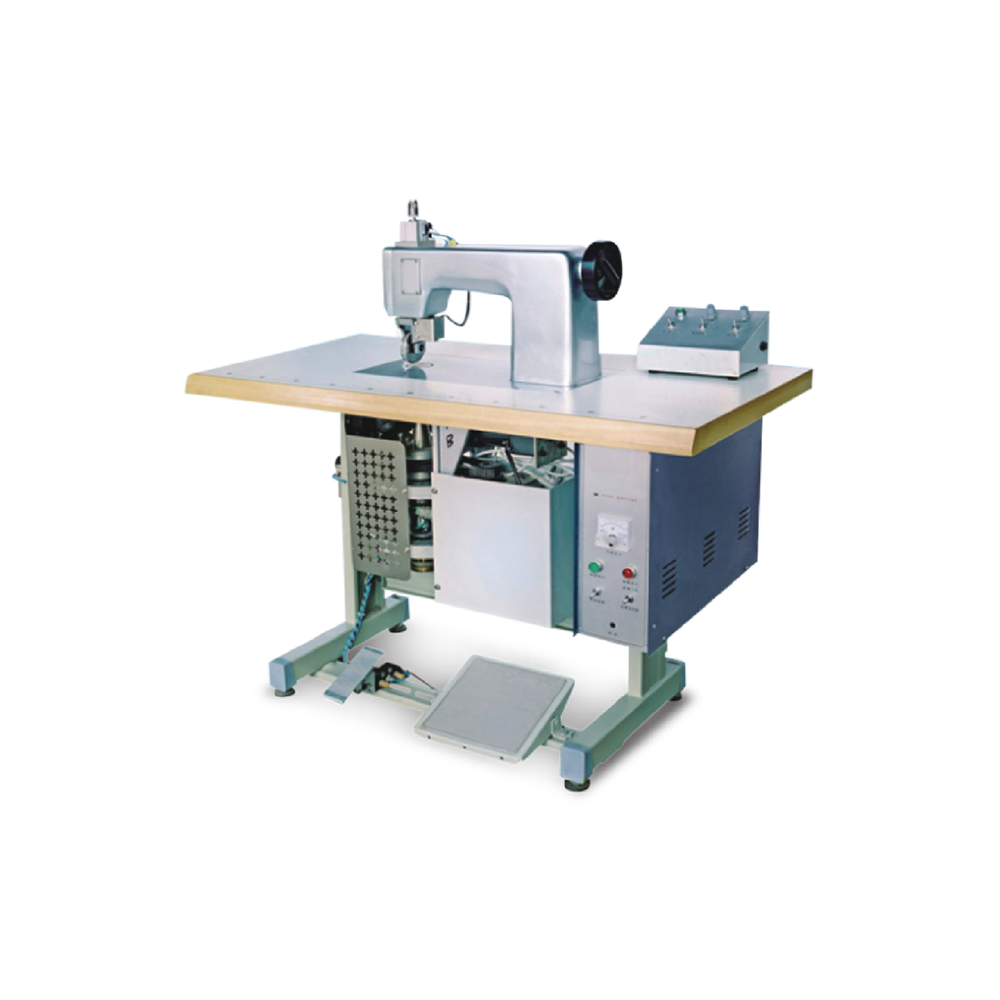
OYANG Ultrasonic Continuous Lace Sewing Machine
Engineered for continuous nonwoven edge sealing, lacing, and automated slitting. Equipped with an auto-tracking 20 kHz acoustic stack and vacuum-carburized alloy pattern rollers (HRC 58–62) to deliver needle-free, continuous seams up to 40 m/min.
- Acoustic Package: 20 kHz continuous duty generator with overload protection
- Operating Speed: Stepless frequency speed regulation up to 40 m/min
- Tooling Standard: Wear-resistant carburized Cr12MoV pattern rollers
Tooling Manuals, Video Verification & Spare Parts Catalogs
Review technical demonstrations and certified operational guidelines from our smart manufacturing campus:
Frequently Asked Questions (FAQ)
What is the average price range for a non woven bag sealing machine?
Equipment pricing starts at $800 to $1,800 for manual benchtop spot welders used for rework or sampling. Semi-automatic pneumatic handle welding machines with automatic loop feeders (like the OYANG15-G-F700) range from $2,500 to $5,500. Continuous rotary ultrasonic lace sewing machines range between $3,200 and $6,800, while automated multi-axis ultrasonic welding stations integrated directly into high-speed bag making lines range from $6,000 to $12,000 per station.
Why does my ultrasonic non woven sealing machine trip with an overload error?
An overload trip (typically Error E-01) occurs when the acoustic stack moves out of its resonant frequency window (19.85 kHz–20.15 kHz) or experiences high acoustic impedance. Primary causes include an overheating sonotrode horn (exceeding 55°C), loose titanium connection studs, interface fretting corrosion, or hairline stress fractures within the horn body. Running an automatic frequency scan and verifying no-load current below 0.8 A will isolate whether the fault is electrical or mechanical.
Should I choose titanium or hardened steel horns for my ultrasonic bag machine?
Titanium alloy (TC4) is the ideal choice for high-speed continuous bag converting because it exhibits low acoustic dampening, generates minimal internal heat, and operates over 12,000 hours with negligible frequency drift. Hardened tool steel (D2 or DC53) is more cost-effective and provides better surface hardness (HRC 58–60) against abrasive nonwovens containing calcium carbonate filler. However, steel horns require compressed-air cooling nozzles to dissipate internal heat and prevent cracking.
What torque is required when assembling ultrasonic transducers and booster horns?
High-tensile titanium studs connecting the transducer, booster, and sonotrode horn must be tightened with a calibrated torque wrench to exactly 45 to 50 N·m. Under-torquing allows micro-gaps to form at the mating surfaces, causing acoustic reflection, joint overheating, and generator tripping. Over-torquing strains the titanium threads and distorts the piezoelectric ceramic discs, degrading acoustic power transmission.
Request Ultrasonic Machinery Pricing & Parts Catalog
Consult with OYANG’s acoustic application engineers. Submit your horn specifications, machine models, or bag converting line requirements to receive certified technical data sheets and official pricing.