350x97.png)
350x97.png)
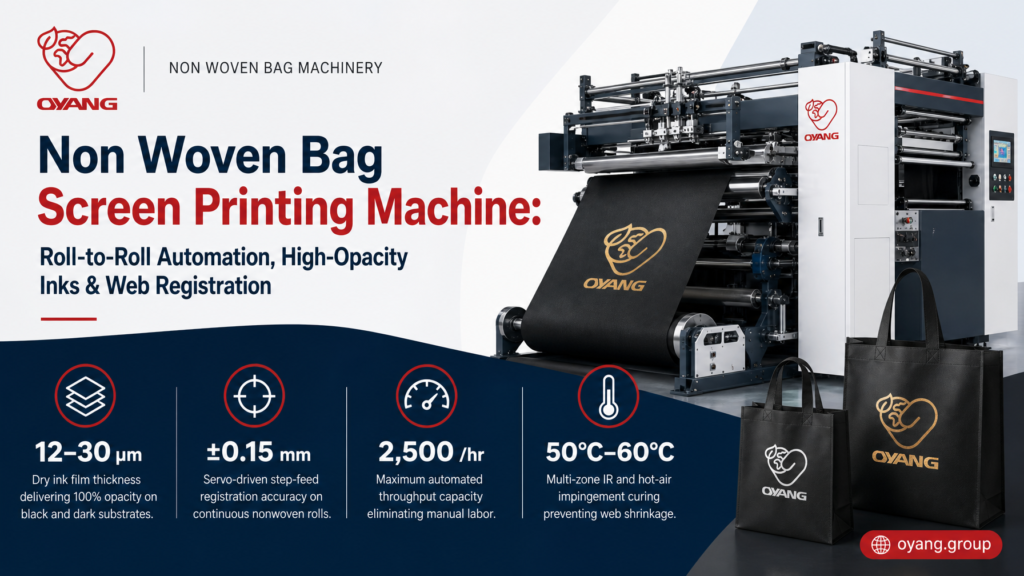
Non Woven Bag Screen Printing Machine: Roll-to-Roll Automation, High-Opacity Inks & Web Registration
A continuous roll to roll non woven screen printing machine applies heavy ink deposits ranging from 12μm to 30μm, delivering 100% visual opacity and tactile gloss on dark-colored polypropylene (PP) spunbond substrates. In contrast to manual flatbed benches or thin-film flexo lines (2μm–5μm ink layers), automated web-fed screen printers utilize high-torque AC servo drives and high-resolution optical fiber registration sensors to achieve color-to-color alignment of ±0.15mm at production velocities between 1,200 and 2,500 impressions/hour, feeding dried, rewinded rolls directly into automated 3D box bag converters.
Dry ink film thickness delivering 100% opacity on black and dark substrates.
Servo-driven step-feed registration accuracy on continuous nonwoven rolls.
Maximum automated throughput capacity eliminating manual printing labor.
Multi-zone IR and hot-air impingement curing preventing web shrinkage.
Why Roll-to-Roll Screen Printing Outperforms Flexo on Dark Nonwovens
Converters producing high-end retail shopping bags, corporate gift bags, and apparel covers frequently encounter poor print quality when using standard flexography on colored spunbond materials. Polypropylene fiber bundles create an uneven, textured topography. While flexographic liquid ink sinks into fiber crevices leaving exposed fabric strands (“pinholing”), screen printing forces high-viscosity paste through an open stencil mesh to establish an unbroken, opaque barrier coat.
| Technical Property | Roll-to-Roll Screen Printing | Flexographic Printing (Flexo) | Manual Screen Printing Table |
|---|---|---|---|
| Wet/Dry Ink Film Thickness | 12μm to 30μm (Extreme saturation) | 2μm to 5μm (Thin translucent layer) | 15μm to 35μm (Inconsistent layer) |
| Ink Opacity on Dark Substrates | 100% Solid opacity (Crisp white/gold) | Partial strike-through / Dull finish | High opacity, but uneven ink laydown |
| Registration Accuracy | ±0.15mm (Closed-loop servo & photo-eye) | ±0.10mm (CI) / ±0.40mm (Stack) | ±1.0mm to ±2.5mm (Human operator error) |
| Production Output Velocity | 1,200–2,500 impressions/hour | 60–120 m/min (Very fast) | 200–350 bags/hour/person |
| Downstream Converting Fit | Continuous rewind rolls feed auto bag lines | Continuous roll feed | Manual conversion only (Cannot feed auto lines) |
| Tooling & Screen Capex | Low ($15–$30 per mesh frame) | High ($120–$250 per photopolymer plate) | Low ($10–$20 per wooden/aluminum frame) |
Precision Web-Fed Step Mechanics: The Anti-Stretch Registration Logic
Nonwoven web-fed screen printing operates on an intermittent step-and-repeat cycle: the fabric unwinds, advances by a defined pitch, stops dead under absolute vacuum hold-down, undergoes squeegee traverse, and accelerates through the multi-stage curing tunnel. Maintaining structural integrity across this start-stop cycle requires specialized mechanical engineering.
1. High-Vacuum Honeycomb Printing Platen with Micro-Adjustment
During the printing stroke, squeegee pressure (typically 4.0 to 6.5 kgf/cm²) applies lateral shear force across the nonwoven web. Without rigid retention, elastic deformation shifts the substrate by 0.5mm to 1.2mm. OYANG screen printers integrate a hard-anodized cast-aluminum vacuum bed featuring thousands of micro-orifices powered by a high-cfm turbine. The vacuum activates instantaneously when the web stops, locking the fabric completely flat against the bed. An integrated 3-axis micrometer stage enables fine mechanical angle calibration (±0.01mm) on the screen clamp rails.
2. Multi-Axis AC Servo Pitch Feeding & Optical Fiber Tracking
The intermittent feed mechanism is driven by an independent AC servo motor coupled directly to precision rubber-coated pinch rollers. To achieve multi-color registration on double-station configurations (such as the OYANG Double Color platform), a high-speed Keyence fiber-optic sensor scans the printed register marks from the first deck within 50 microseconds. The secondary servo automatically calculates pitch offset and compensates for micro-stretching, keeping color registration tightly restricted to ≤ ±0.15mm.
3. Dual-Zone IR Curing with Impingement Air Flow
Because screen printing deposits 5× more ink volume than flexo, rapid drying without polymer shrinkage is critical. Spunbond polypropylene softens at temperatures exceeding 70°C. OYANG roll-fed lines deploy an extended medium-wave infrared (IR) heating tunnel combined with ambient-temperature blowers. The IR wavelength specifically excites the water molecules in the ink formulation, achieving skinning and curing within 8 to 12 seconds at 50°C–60°C. The web then passes across chilled outfeed rollers to stabilize fabric tension before rewind tensioning, eliminating roll blocking or ink offsetting.
Photochemical Screen Stencil Preparation: Engineering Standard
Achieving sharp definition on porous spunbond nonwoven substrates requires an optimized screen platemaking protocol. Utilizing incorrect mesh counts causes either screen clogging or heavy ink bleeding:
- Monofilament Polyester Mesh Selection: Select yellow low-elongation monofilament polyester mesh. For standard opaque white and bright corporate branding, deploy 100 to 120 mesh/inch (40–48 threads/cm) with a 55μm thread diameter. For ultra-fine typography and intricate micro-graphics, step up to 140 to 160 mesh/inch.
- Pneumatic Frame Tensioning: Mount mesh on high-rigidity hollow aluminum alloy frames (40mm × 60mm × 2.5mm wall). Tension uniformly via multi-clamp pneumatic stretchers to 22 ± 2 N/cm. Allow 24-hour mechanical relaxation before final adhesive bonding to prevent tension loss during high-speed squeegee travel.
- Diazo Dual-Cure Direct Emulsion Coating: Apply a high-solids water-resistant diazo emulsion using a precision scoop coater (2+2 wet-on-wet coating technique). The calculated emulsion over mesh (EOM) ratio must reach 18%–22% to create a clean gasket seal against the textured nonwoven surface, completely eliminating edge feathering.
- UV Exposure & Post-Hardening: Expose under a 3 kW metal halide UV source or digital LED UV system using an exposure calculator step tablet. Following washout, apply a chemical water-resistant stencil hardener (cross-linking agent) to enable the screen to withstand over 50,000 continuous squeegee passes without pinholing.
OYANG Roll-to-Roll Nonwoven Screen Printing Machines
Engineered inside OYANG’s 130,000&mflat; manufacturing facility, all machine frames and precision drive carriages are processed on Japanese MAZAK and OKUMA CNC centers to ensure zero vibration and perfect squeegee parallelism:

Single-Color Roll-to-Roll Screen Printer
The standard industrial platform for high-volume solid brand logos, luxury retail packaging, and single-color promotional bags with extreme opacity.
- Production Speed: 1,200 – 2,500 impressions/hour
- Max Printing Area: Up to 600mm × 800mm
- Curing Configuration: Integrated high-velocity IR dry tunnel

Double-Color Roll-to-Roll Screen Printer
Dual-station printing cell equipped with closed-loop optical register sensors for precise two-color registered graphics on dark nonwoven rolls.
- Registration Precision: ≤ ±0.15mm closed-loop servo
- Inter-Station Curing: Intermediate flash cure + bridge dryer
- Substrate Compatibility: 30–120 g/m² nonwoven and paper webs
Video Case Study: Roll-to-Roll Automatic Screen Printing in Motion
Frequently Asked Questions (FAQ)
Upgrade to Automated Roll-to-Roll Screen Printing
Eliminate manual printing labor and achieve flawless opacity on dark substrates. Speak directly with OYANG application engineers to receive custom layout drawings, drying capacity calculations, and Proforma Invoices.
Download Printing & Converting Brochure (PDF)