

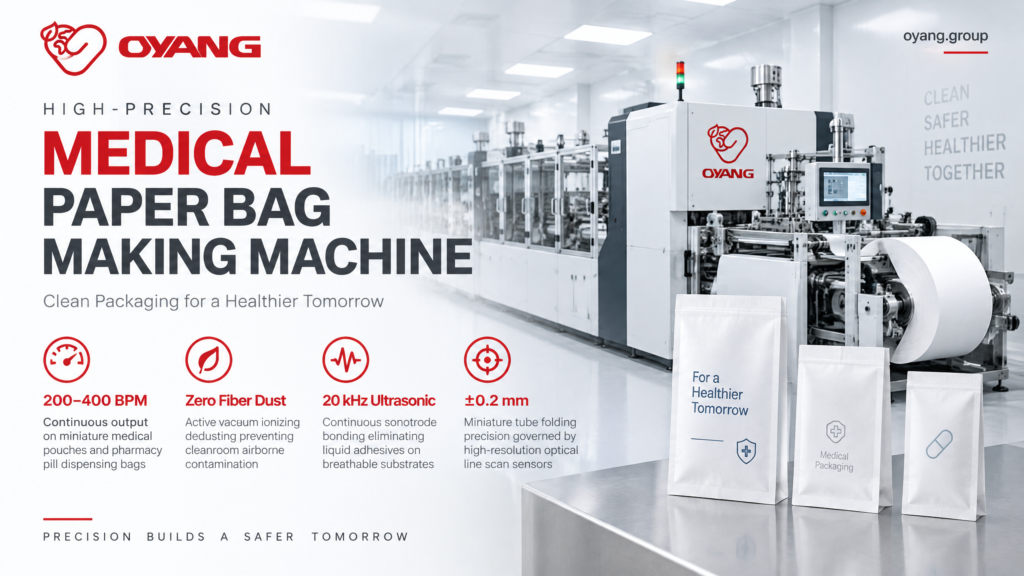
A high-precision medical paper bag making machine (also configured for pharmaceutical dispensing lines as a medicine paper bag making machine or delicate-substrate tissue paper bag making machine) converts medical-grade dialysis paper (45–70 GSM), Tyvek, and breathable microbial barrier laminates into sterile packaging pouches. Built to satisfy Class 100,000 cleanroom standards, specialized converting lines such as the OYANG 16C Medical Configuration integrate 20 kHz rotary continuous ultrasonic sealing, enclosed stainless-steel doctoring applicators, and optical web ionizing de-dusters. These systems achieve continuous production speeds of 200 to 400 bags per minute on miniature pharmacy formats (face widths from 50 to 160 mm), holding transverse cutoff and seam alignment tolerances strictly within ±0.2 mm without producing paper-lint particulates.
Sanitary & Cleanroom Requirements in Medical Converting
Unlike conventional shopping bag converting, pharmaceutical and healthcare packaging machinery operates under strict international regulatory frameworks, including ISO 11607-1 (Packaging for Terminally Sterilized Medical Devices) and GMP Cleanroom Class 100,000 (ISO Class 8) guidelines.
Standard packaging machinery cannot be deployed in cleanroom environments due to four critical contamination vectors:
- Paper-Lint Particulates: Conventional high-speed shears tear uncalendered kraft fibers, creating airborne dust clouds that compromise device sterility.
- Lubricant Aerosolization: Open oil chains and mechanical grease fittings expel micro-droplets under high rotational velocities.
- Adhesive Stringing & Volatiles: Solvent-based or open-pot liquid glues emit volatile organic compounds (VOCs) and create adhesive airborne filaments.
- Microbial Porosity Disruption: Mechanical impact knives crush the porous matrix of medical dialysis papers, preventing proper Ethylene Oxide (EtO) or gamma radiation penetration.
To review the fundamental mechanics behind roll-fed continuous feeding and tube-forming kinematics, see our in-depth engineering analysis on how paper bag making machine works: Step-by-step engineering principles.
Kinematic Principles of Medical Pouch Forming & Ultrasonic Sealing
A high-speed medicine paper bag making machine replaces mechanical impact blades and wet glue baths with cleanroom-certified mechatronic sub-assemblies:
1. Continuous 20 kHz Ultrasonic Sealing Modules
When converting synthetic medical paper, Tyvek, or coated dialysis paper, thermal glue lines can block the breathability of the pouch. OYANG medical-grade units deploy continuous rotary ultrasonic horns vibrating at 20 kHz. The high-frequency acoustic friction plasticizes the polymer microfibers at the molecular level within 0.05 seconds, creating a continuous, hermetic, lint-free bond without introducing foreign chemical adhesives.
2. Active Web Ionization & Vacuum Scavenging
Lightweight medical paper rolls easily generate static charges exceeding 15 kV during high-speed unwinding, attracting ambient airborne particles. The machine integrates dual anti-static ionizing bars (pulsed DC) upstream of the forming station, accompanied by high-vacuum HEPA-filtered capture hoods that evacuate paper fibers directly at the slitting and perforating points.
3. Miniature Tube Folding Mandrels (±0.2 mm Precision)
Standard commercial shopping bags have face widths of 180 to 450 mm. A tissue paper bag making machine or pharmacy pouch maker often runs micro-formats with face widths as narrow as 50 to 120 mm. Symmetrical folding on such narrow formats requires CNC-machined SUS304 stainless-steel adjustable forming mandrels with micro-honed radii, preventing surface creasing or web wrinkling under tension.
4. Closed-Loop Food & Pharma Grade Water-Based Cold Gluing
Where water-based adhesive is mandated for pharmacy dry-pill pouches, the system utilizes fully enclosed pressurization circuits with high-speed electromagnetic jetting valves or precision-metered micro-applicator wheels. Non-contact spray nozzles dispense dot-matrix glue beads with micro-millimeter precision, eliminating centrifugal glue fling-off at 400 BPM.
Engineering Video: OYANG High-Speed Converting Kinematics in Real-Time
Observe the synchronized rotary flying cutoff, precise edge alignment, and continuous pouch delivery architecture running on the OYANG C330 series platform:
Video 1: Real-time high-speed small-format converting on the OYANG 16C (C330) production line.
Field Engineering Diagnosis: Troubleshooting Medical Pouch Defects
In cleanroom medical packaging, microscopic seam defects cause loss of sterility and product recalls. Use this diagnostic calibration table for workshop quality assurance:
| Pouch Integrity Defect | Root Mechanical / Physical Cause | Standard Workshop Calibration Protocol |
|---|---|---|
| Microbial Seal Channeling / Void | Sonotrode horn acoustic resonance drift; uneven pneumatic horn clamp pressure across the 15 mm seal width. | Retune ultrasonic generator frequency to 20.05 kHz center; re-level sonotrode face parallelism using feeler gauges to within ≤ 0.008 mm. |
| Cleanroom Fiber Particle Spike | Dull tungsten rotary slitting blade tearing unbleached paper fibers; HEPA vacuum hood velocity dropped below 18 m/s. | Replace carbide rotary slitter blade; check and clear HEPA filter differential pressure gauge (ΔP ≤ 150 Pa). |
| Miniature Tube Skew (> 0.3 mm) | Differential traction across narrow 50 mm web; static adhesion causing erratic drag against stainless-steel forming plate. | Increase ionizing bar output to 7.5 kV; re-center optical web edge tracker; adjust forming plate nip roll gaps to identical clearance. |
| Substrate Embrittlement / Pinholes | Ultrasonic energy over-exposure due to line speed deceleration without automated amplitude down-ramping. | Configure PLC velocity-proportional ultrasonic power scaling (modulating amplitude between 40% and 100% proportional to line speed). |
Medical Pouch Converting vs. Standard Retail Paper Bag Converting
Manufacturing facilities evaluating cleanroom medical paper bag lines must account for technical differences across mechanical, hygiene, and tooling specifications:
| Technical Parameter | Medical / Pharma Sizing Machine (OYANG 16C Clean) | Standard Commercial SOS Machine (SMART-17 / TECH-18) |
|---|---|---|
| Paper Bag Width Range | 50 – 160 mm (Miniature Formats) | 150 – 330 mm (Standard Formats) |
| Sealing / Bonding Method | 20 kHz Ultrasonic or Clean Jet Cold Adhesive | Rotary cold glue wheel + EVA hot-melt patch |
| Cleanroom Compatibility | Class 100,000 (ISO 8) / Fully Enclosed Drive Belts | General industrial shop floor environment |
| Lubrication Architecture | Sealed-for-life food/pharma grease (NSF H1) | Centralized automatic oil circulating pump |
| Applicable Substrates | Medical dialysis paper, Tyvek, heat-seal barrier paper | Virgin brown/white kraft, recycled kraft (60–180 GSM) |
| Target End-Use Market | Sterile syringes, surgical blades, pharmacy tablets | Retail apparel, grocery shopping, restaurant takeout |
OYANG Flagship Equipment Solutions for Medical Packaging
Operating high-speed converting machinery in cleanrooms requires complete isolation of mechanical wear components. Standard cast iron surfaces shed microscopic oxidation particles. OYANG sanitary lines feature hard-chrome-plated guide bars, nickel-electroless plated side panels, and enclosed servo drives:
OYANG 16C: High-Velocity Medical & Pharmaceutical Pouch Line
The OYANG 16C High-Speed V-Bottom Paper Bag Making Machine can be tailored for medical and cleanroom environments. It operates reliably from 200 to 400 bags/min on delicate barrier papers with bag widths from 80 to 330 mm and cut lengths from 160 to 710 mm. When equipped with inline ultrasonic sonotrodes and pneumatic auto-ejection for reject bags, it provides total process validation for healthcare converters.

Figure 1: The OYANG 16C High Speed Paper Bag Making Machine (C330) configured for cleanroom converting.
To understand how roll-fed servo kinematics and electronic registration coordinate across diverse production platforms, explore our technical breakdown on OYANG Paper Bag Machine Guide: High-Speed Smart Packaging Solutions.
For operators assessing capital expenditures and labor allocation differences between automated systems and standalone cells, review our analysis on semi-automatic vs. fully automatic bag machines: Labor vs. automation guide.
To verify the Japanese MAZAK and OKUMA 5-axis CNC machining centers that guarantee our ≤ 0.015 mm tolerances, read about Ounuo Machinery: High-Precision Eco-Packaging Manufacturing at OYANG Group.
Related Technical Guides & Converting Resources
- → How Paper Bag Making Machine Works: Step-by-step kinematic sequence, servo axis coordination, and bottom-folding mechanics.
- → OYANG Paper Bag Machine Guide: In-depth technical breakdown of the TECH-18 and SMART-17 converting lines, servo kinematics, and inline handle integration.
- → Semi-Automatic vs. Fully Automatic Bag Machines: Labor overhead, format flexibility, and unit break-even comparisons.
- → Ounuo Machinery High-Precision Manufacturing: Explore the Japanese MAZAK and OKUMA 5-axis CNC machining bays powering OYANG Group’s machinery lines.
Frequently Asked Questions (FAQ)
What makes a medical paper bag making machine compliant with cleanroom standards?
Cleanroom compliance requires fully enclosed drives, sealed NSF H1 food-grade lubrication, stainless-steel web touchpoints, active web ionization to neutralize static charges, and localized HEPA-filtered vacuum extraction to capture microscopic paper dust before it disperses into the cleanroom atmosphere.
Why is ultrasonic sealing preferred over liquid adhesives for medical dialysis paper?
Medical dialysis paper and synthetic breathable substrates require controlled gas permeability for sterilization (EtO or steam). Liquid cold or hot-melt adhesives can migrate into the porous paper matrix, blocking breathability and releasing volatile organic compounds (VOCs). Ultrasonic sealing creates a molecular polymer bond using 20 kHz acoustic friction, delivering 100% clean, adhesive-free seals that preserve microbial barrier properties.
Can a medicine paper bag making machine handle delicate 45 GSM lightweight paper?
Yes. Handling delicate 45–55 GSM medical paper requires closed-loop pneumatic dancer tension control and ceramic-coated, low-inertia aluminum rollers. The system regulates unwind web tension within ±0.05 N, preventing web elongation or surface tearing during high-speed acceleration ramps.
What are the minimum bag dimensions achievable on a medical pinch pouch machine?
Engineered specifically for small-format healthcare packaging, platforms like the OYANG 16C Medical Configuration achieve minimum bag face widths as narrow as 50 to 80 mm and cut lengths down to 160 mm, making them ideal for single-dose pharmaceuticals, surgical instruments, and medical swab packaging.