350x97.png)
350x97.png)
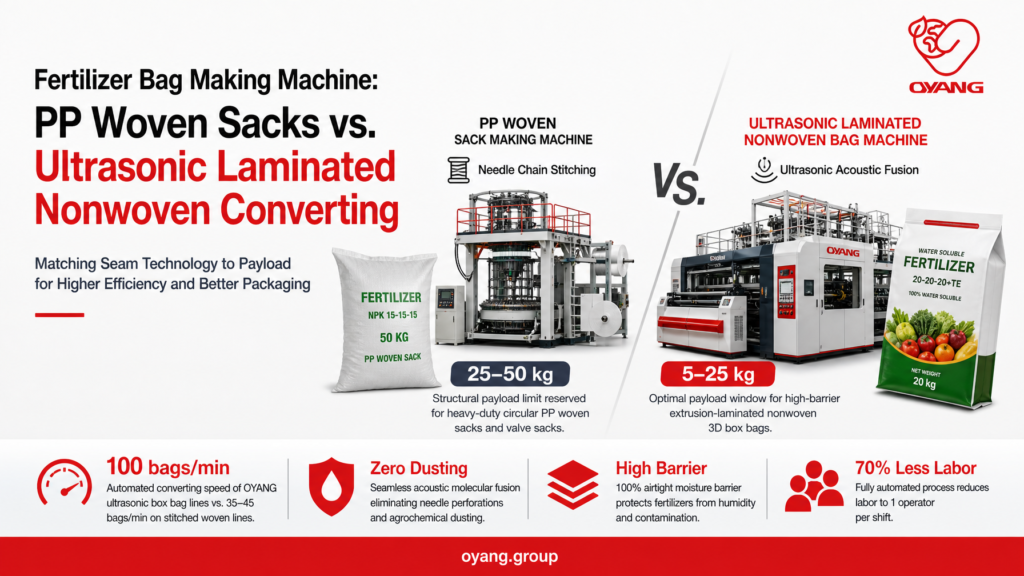
Fertilizer Bag Making Machine: PP Woven Sacks vs. Ultrasonic Laminated Nonwoven Converting
Selecting a fertilizer bag making machine requires matching mechanical seam technology to package payload: traditional PP woven sack making machines utilize circular looms and needle chain stitching to handle heavy bulk loads of 25kg to 50kg (such as Portland cement and field fertilizers), but suffer from needle-punched powder dusting and labor-intensive manual sewing. Conversely, for high-value retail packaging of 5kg to 25kg (such as water-soluble fertilizers, specialty agrochemicals, and seed grains), fully automated ultrasonic laminated nonwoven box bag machines achieve 100% airtight moisture barriers, pinhole-free seams, and high-definition rotogravure branding at production speeds up to 100 bags/min with 70% less labor.
Structural payload limit reserved for heavy-duty circular PP woven sacks and valve sacks.
Optimal payload window for high-barrier extrusion-laminated nonwoven 3D box bags.
Automated converting speed of OYANG ultrasonic box bag lines vs. 35–45 bags/min on stitched woven lines.
Seamless acoustic molecular fusion eliminating needle perforations and agrochemical dusting.
Material Architecture: Circular Slit Tapes vs. Extrusion-Laminated Spunbond
The choice between woven and nonwoven equipment is rooted in the polymer physics of the raw substrate. Polypropylene (PP) resins are processed into drastically different structural formats to satisfy either raw tensile strength or multi-layer barrier containment:
1. Polypropylene Woven Fabric (Circular Loom Architecture)
PP woven sacks begin with extruded film water-bath quenched and slit into continuous tapes (2.0mm to 3.0mm width), which undergo high-ratio mono-axial mechanical stretching (5:1 to 7:1 ratio) to align polymer chains. These high-tenacity tapes are woven into seamless tubular fabrics on 4-shuttle or 6-shuttle circular looms. The resulting fabric exhibits exceptional tensile break loads exceeding 800 N to 1,200 N per 50mm strip, enabling bags to survive violent drop impacts when filled with 50 kg of dense urea granules or cement powders.
2. Extrusion-Laminated Nonwoven Matrix (Composite Barrier Architecture)
Spunbond nonwoven fabric is composed of randomized continuous extruded microfilaments calendered into an isotropic web (typically 60–90 g/m²). While raw nonwoven has a lower tensile rating than woven tapes, OYANG lines deploy a 3-layer extrusion laminate structure: BOPP Reverse-Printed Film (18μm) + Extruded PP/PE Bonding Tie Layer (15–20 g/m²) + PP Spunbond Substrate (70–80 g/m²). This creates a rigid, waterproof composite sheet with a burst strength capable of securely packaging 5kg to 25kg agricultural products while delivering photographic retail shelf appeal.
Converting Mechanics: Needle-Punched Chain Stitching vs. Acoustic Fusion
How the bottom and top seams are enclosed dictates both plant operating efficiency and final packaging barrier integrity:
| Engineering Parameter | PP Woven Sack Making Machine (Bag Cutting & Stitching) | OYANG Automated Ultrasonic Laminated Bag Machine |
|---|---|---|
| Seam Joining Technology | Mechanical needle chain stitch (Polyester sewing thread) | 15/20 kHz High-frequency acoustic molecular fusion |
| Production Converting Velocity | 35–45 bags/min (Limited by mechanical needle reciprocating speed) | 80–100 bags/min (Continuous servo-fed line) |
| Powder Leakage & Sifting | High risk; powder sifts through needle puncture holes | Zero leakage; hermetic molecular polymer weld |
| Moisture & Atmospheric Barrier | Requires manual inserted LDPE inner liner bag | Built-in barrier (Extrusion-coated BOPP/PP composite) |
| Seam Consumables Overhead | High (Continuous consumption of sewing thread & needle oil) | Zero consumables ($0 thread, $0 adhesives) |
| Labor Requirement per Shift | 3–4 Workers (Roll hanging, thread tying, sewing supervision) | 1 Operator (Fully automatic reel-to-box-bag process) |
| Package Aesthetics & Branding | Coarse flexo print or wrinkly tubular BOPP laminate | Rigid 3D box shape with 5-sided 400 m/min rotogravure graphics |
Plant Decision Matrix: When to Deploy Woven vs. Nonwoven Lines
Packaging plant operators and agricultural supply groups must categorize their product lines by bulk density, target shelf environment, and distribution channels:
- Select PP Woven / Valve Sack Machinery For:
- Portland Cement & Dry Construction Mortars (25kg–50kg): Mandatory deployment of automated tubular woven valve bag machines. High air permeability allows rapid de-aeration during impeller packing spouts, while woven tensile strength survives coarse handling.
- Bulk Field Fertilizers & Basic Urea (50kg Bulk Tonnage): Standard woven sacks with sewn bottoms remain the most economical bulk containment format where aesthetic branding is secondary to puncture resistance.
- Select OYANG Laminated Nonwoven Converting Lines For:
- High-Value Water-Soluble Fertilizers & Micronutrients (5kg–25kg): Chemical hygroscopic salts degrade upon contact with atmospheric humidity. Ultrasonic fused composite nonwoven box bags provide airtight protection without costly manual inner liners.
- Premium Agricultural Seeds & Hybrid Grains (5kg–10kg): High-end seed companies require photographic rotogravure branding, tamper-evident tear notches, and stand-up display profiles to command premium retail pricing.
- Retail Animal Feed, Pet Food & Premium Rice (10kg–20kg): Eliminates thread unravelling failures while providing reinforced punch handles for consumer carry convenience.
OYANG Full-Chain Laminated Nonwoven Packaging Solution
For converters transitioning from low-margin commodity woven sacks to high-value retail agricultural packaging, OYANG provides a complete, vertically integrated production line manufactured to ≤ 0.015mm tolerances on MAZAK and OKUMA CNC centers:

1. HONOR 4.0 ELS Rotogravure Printing Press
Prints reverse photographic artwork onto BOPP film webs at 400 m/min with ±0.05mm electronic line shaft (ELS) servo precision, delivering retail-grade graphics.
- Printing Speed: Up to 400 m/min
- Tension Precision: Ultra-sensitive floating dancer tension control
- Color Capability: 8–10 colors with auto-defect inspection

2. High-Speed Extrusion Lamination Line
Thermal extrusion coating unit that bonds printed BOPP film to PP nonwoven rolls using molten polypropylene resin, ensuring high peel strength and absolute waterproofing.
- Lamination Speed: Up to 300 m/min continuous web
- Coating Uniformity: ±1.0 g/m² high-precision T-die extrusion
- Peel Strength: Delamination-proof barrier matrix

3. OYANG 20 Fully Automatic Box Bag Line
The industrial flagship line converting laminated composite rolls into rigid 3D square-bottom bags with handles at 80–100 bags/min via digital 15/20 kHz ultrasonic horns.
- Production Speed: 80–100 bags/min (Up to 6,000 bags/hour)
- Bag Formation: 3D Box bag, soft-loop handle, D-cut
- Seam Reliability: Reinforced acoustic weld holding >15–20 kg
Video Case Study: Complete Extrusion-Laminated Bag Production Flow
Frequently Asked Questions (FAQ)
Upgrade from Woven Sacks to Laminated Nonwoven Packaging
Capture premium agricultural and chemical packaging accounts with airtight, photographic laminated box bags. Contact OYANG process engineers to evaluate fabric tensile ratings, rotogravure print cylinders, and complete turnkey extrusion line layouts.
Download 2026 Machinery Brochure (PDF)