350x97.png)
350x97.png)
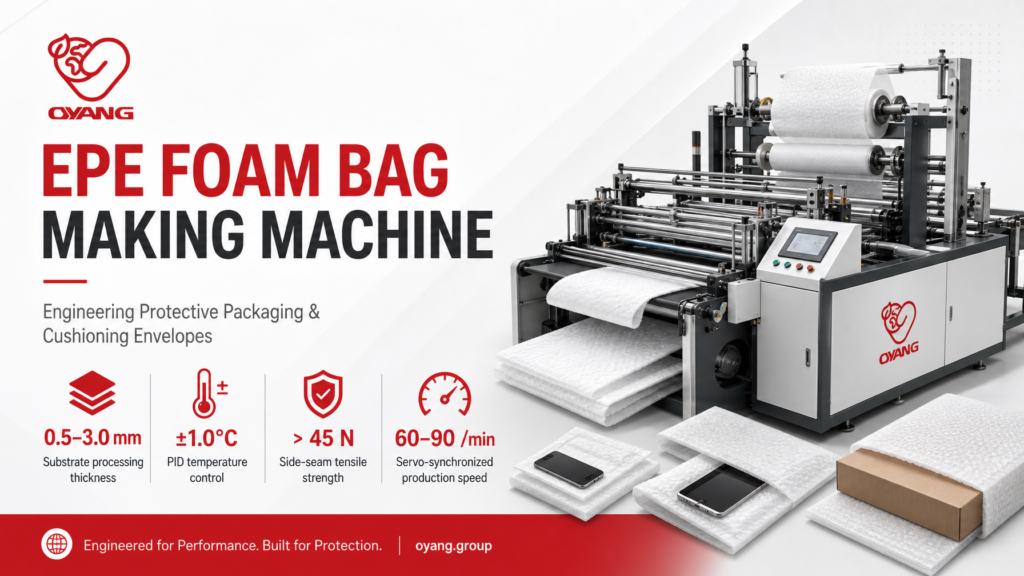
EPE Foam Bag Making Machine: Engineering Protective Packaging & Cushioning Envelopes
An industrial EPE foam bag making machine is an engineered converting line designed to process expanded polyethylene (EPE) sheet foam (thicknesses from 0.5mm to 3.0mm), laminated air bubble films, and composite nonwoven protective mailers. Unlike standard thin-film bag machines that overheat and collapse cellular air bubbles, specialized EPE converting lines utilize dual-sided constant-temperature heat-sealing bars synchronized with pneumatic boost cold-shear cutting. Operating with PID thermal tolerances within ±1.0°C, these machines eliminate burn-through defects and achieve seam tensile weld strengths exceeding 45 N at production rates up to 60–90 bags/min.
Substrate processing thickness for pure EPE sheet, multi-layer laminated bubble film, and composite foam.
Microprocessor PID temperature regulation preventing cellular gas pocket rupture and smoke generation.
Side-seam mechanical tensile shear strength withstanding heavy 3C electronics and drop impacts.
Continuous servo-synchronized production speed for e-commerce courier cushioning pouches.
Thermal Dynamics: Why Conventional Bag Cutters Fail on EPE Foam
Expanded Polyethylene (EPE) foam is fundamentally an engineered thermal insulator composed of thousands of independent closed-cell gas bubbles (density 18–35 kg/m³). When bag converters attempt to process EPE using standard rotary heat-wire or hot-knife cutters, severe structural failures occur:
1. The “Insulation Trap” & Heat Saturation Lag
Standard bag making machines rely on rapid contact heat transfer through thin poly films (20μm–80μm). Because EPE foam contains trapped air pockets, its thermal conductivity is extremely low ($$k \approx 0.034\text{ W/(m}\cdot\text{K)}$$). A conventional hot knife heats only the outermost surface skin while the inner foam core remains unmelted. Increasing the knife temperature causes the outer polyethylene skin to burn, emit toxic smoke, and degrade polymer chains, resulting in weak, unbonded side seams that split open when items are inserted.
2. Cellular Collapse & Perimeter Thinning
Excessive thermal exposure ruptures the microcellular cell walls. As trapped gas escapes, the 2.0mm thick foam collapses into a razor-thin, brittle 0.1mm bead right along the seal line. This abrupt transition from thick resilient foam to an embrittled polymer bead creates a high mechanical stress notch, causing packaging mailers to fail catastrophically during shipping container vibration.
The Engineering Solution: Dual-Sided Hot Melting & Cold Shear Trimming
To overcome the insulating barrier of thick EPE and air bubble laminates, OYANG engineering incorporates a decoupled sealing-and-shearing mechanical cycle:
| Process Station | Conventional Hot-Knife Machine | OYANG Decoupled EPE Converting Architecture |
|---|---|---|
| Thermal Application | Single overhead reciprocating knife (Blade edge sealing) | Dual-sided copper-alloy heating bars (Upper & lower thermal penetration) |
| Heat Transfer Method | Direct contact cutting wire under tension | Controlled-dwell contact heating bar with Teflon-matrix non-stick coating |
| Web Cutting Mechanism | Thermal burn-melt through web | Independent pneumatic high-pressure cold shear blade (Crusher-free cut) |
| Seam Cooling / Quenching | Ambient air cooling on open belt | Water-chilled aluminum clamping jaws locking molecular crystallization |
| Seam Integrity & Thickness | Weak, brittle film bead (< 15 N tensile) | Reinforced fused polymer matrix retaining > 60% of original foam bulk |
Multi-Layer Lamination Matrix: EPE Composites & Sealing Tolerances
E-commerce fulfillment demands hybrid protective structures combining cushioning with surface scratch protection or moisture shielding. Each composite formulation requires calibrated machine parameters:
| Composite Material Structure | Total Thickness Range | Optimal Sealing Temp | Pneumatic Nip Pressure | Target Industrial Application |
|---|---|---|---|---|
| Pure Virgin EPE Sheet | 0.5mm – 2.0mm | 165°C – 180°C | 0.25 – 0.35 MPa | Appliance scratch protection, glassware sleeves |
| EPE Foam + LDPE Film Laminate | 1.0mm – 3.0mm | 175°C – 195°C | 0.35 – 0.45 MPa | Waterproof courier mailer bags, automotive spare sleeves |
| EPE Foam + PP Spunbond Nonwoven | 1.0mm – 2.5mm | 185°C – 210°C | 0.45 – 0.55 MPa | Luxury handbag dust covers, high-end furniture wrap |
| Co-Extruded Air Bubble Film + EPE | 2.0mm – 5.0mm (Compressed) | 190°C – 220°C | 0.50 – 0.60 MPa | Heavy-duty 3C electronic courier envelopes |
| Aluminized Foil + EPE Thermal Barrier | 1.5mm – 3.0mm | 205°C – 230°C | 0.55 – 0.65 MPa | Cold-chain pharmaceutical & perishable food liners |
The 4-Stage Converting Sequence for Protective Cushioning Mailers
Converting resilient, elastic foam roll-stock requires specialized tension control to prevent permanent foam compression before forming:
- Surface-Driven Unwinding with Ultrasonic Diameter Sensing: Traditional center-shaft friction unwinds crush delicate foam layers under high winding core torque. OYANG utilizes a wide rubber surface-belt unwinder. An ultrasonic sensor tracks master roll diameter, maintaining constant zero-stretch web feed under ultra-low web tension (< 10 N).
- Longitudinal Continuous Edge Folding & Bottom Gusseting: The flat foam sheet passes over a mirror-finished low-friction triangular forming collar. Teflon-coated guide rollers fold the web into a continuous folded tube without scraping the exterior surface. For stand-up protective envelopes, an inline motorized wheel forms an internal bottom gusset.
- Dual-Action Hot-Weld Thermal Penetration: At the sealing station, dual heated brass tooling heads descend from above and below simultaneously. Under microprocessor PID control, heat transfers inward from both faces, melting the internal polyethylene resin while water-cooled side dams prevent heat from escaping into the body cushioning bubbles.
- Pneumatic Flying Cold Shear & Release: Immediately following the sealing station, a hardened tool-steel rotary cold-shear blade cuts cleanly through the welded seam. The finished cushioning pouch is discharged onto a shingling accumulation belt without stringing, smoking, or edge curling.
Related Converting Equipment & Auxiliary Machinery
To establish a complete protective packaging manufacturing cell, OYANG manufactures a comprehensive suite of precision converting machines engineered inside our 130,000&mflat; CNC manufacturing facility:

ONL-XE1800 Roll Slitting Machine
Heavy-duty master roll slitter rewinder for wide foam webs, protective nonwoven laminates, and barrier film rolls with precision taper tension control.
- Working Width: Up to 1,800mm master webs
- Slitting Speed: Up to 300 m/min continuous
- Knife Systems: Rotary circular shear blades and razor slitting

High-Speed Extrusion Coating Line
Thermal extrusion coating unit that bonds PE film, aluminized barriers, or spunbond nonwoven to EPE sheet substrates, producing high-barrier cushioning composite rolls.
- Lamination Speed: Up to 300 m/min web travel
- Coating Uniformity: ±1.0 g/m² high-precision T-die extrusion
- Composite Bonding: High-peel strength delamination-proof matrix

ONL-BP500 Automatic End-of-Line Bagging
Automatic bundling and bagging line that gathers stacked protective foam envelopes into outer waterproof polythene bundles, reducing manual warehouse labor.
- Packing Velocity: 10–15 bundles/min
- Stack Capacity: 25 to 100 cushioning pouches per pack
- Control Interface: Siemens PLC with touchscreen diagnostic interface
Frequently Asked Questions (FAQ)
Upgrade Your Protective Packaging Production Line
Eliminate weak seams, burnt edges, and low converting speeds. Send your EPE foam and bubble laminate rolls to the OYANG engineering laboratory for complimentary weld testing and cycle-time validation.
Download Converting Machinery Brochure (PDF)